An open day only pays off if the people who register turn up, and the people who turn up apply. Between those stages, applicants drop away for reasons that come down to messages: the confirmation nobody read, the reminder that went to an old email address, the follow-up that went out a week too late.
Running those messages on WhatsApp, as a short sequence from registration to offer, is how institutions close the gap. University College Birmingham moved its winter event follow-up from SMS to WhatsApp with Cue and saw event conversion rise from 41% in 2024 to 62% in 2025.
Here's the sequence, stage by stage.
Where open days lose applicants
There are three leaks, and each one is a messaging gap:
Registered, didn't come. The confirmation was buried and nobody reminded them.
Came, didn't apply. Nobody followed up while the visit was still fresh.
Applied, didn't accept. The offer arrived and nobody chased it before the deadline.
The sequence below doesn't stop at the thank-you message. It runs all the way to an accepted offer, because an unanswered offer is the most expensive place to lose an applicant: by then you've done all the work.
Before the day: confirm and remind
Registration can start from a web form, a click-to-WhatsApp ad on Facebook or Instagram, or the WhatsApp chat widget on your website. However it starts, the confirmation should land in WhatsApp straight away.

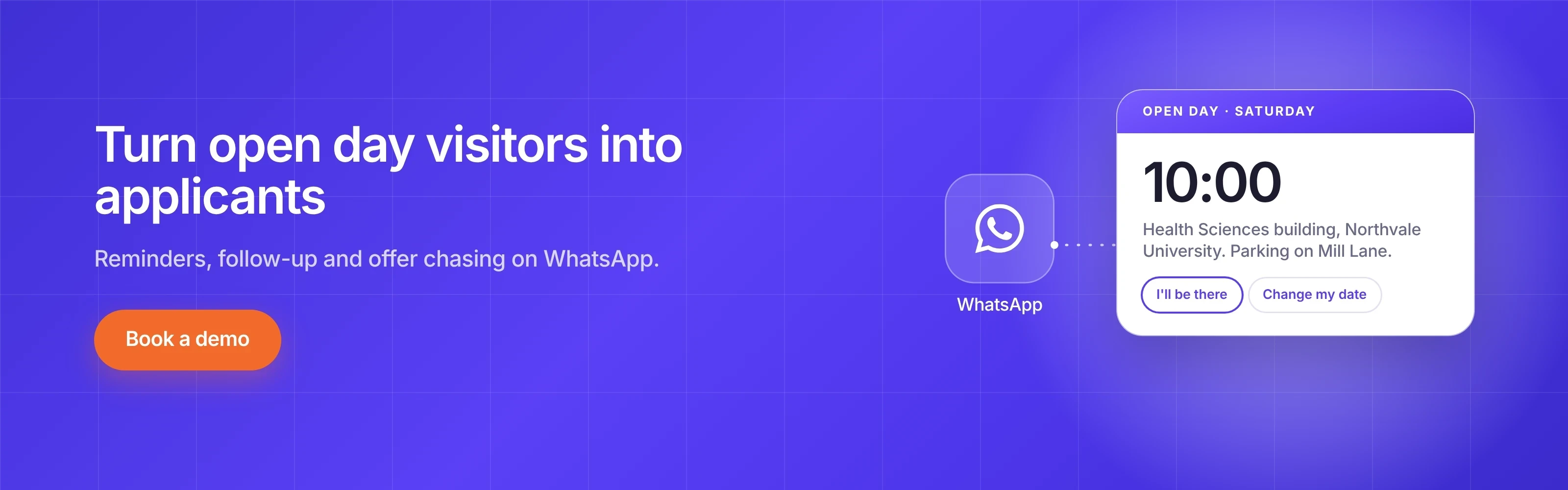
At registration. Confirm the event, date and time, with two reply buttons: "I'll be there" and "Change my date". A change request goes to your team, or to a short journey offering the next date.
The day before. Send a reminder with the start time, directions and parking, and the same reply options. People who can't make it tell you, which gives you a list to follow up rather than a silent no-show.
Both are administrative messages about something the person has already booked, which is the kind of update Meta classes as Utility. Meta makes the final call on each template's category.
On the day: capture details without paper
Replace the paper sign-up sheet with a QR code at the registration desk or on your stand at a school visit. Scanning it opens a WhatsApp chat with your institution, and a short Flow asks a few questions: name, course interest and when they're looking to start. The details are saved against the contact, ready for follow-up, without anyone typing up a list on Monday.
Use the same approach at UCAS fairs and school visits in the UK, or at career expos and campus visits in South Africa, so every lead lands in one place with a record of where it came from.
After the day: follow up within a day
Follow-up works best while the visit is still fresh. Send two different messages:
Attendees get a thank-you and a direct route to the application, with a reply option for questions. Anyone who asks something reaches an adviser in the same thread.
No-shows get a short message offering the next date or a call with an adviser.
These messages encourage someone to apply, so Meta is likely to class them as Marketing, and they need the person's consent to receive marketing. In the UK that means PECR and UK GDPR; in South Africa, POPIA section 69. Our WhatsApp vs SMS guide covers both.
Offer stage: make accepting a one-tap reply
The offer is where open day effort turns into an enrolment, and it's where follow-up can stop.

Send the offer in the same WhatsApp thread the applicant has been using, with three reply buttons: "Accept my offer", "I have a question" and "Decline". Questions go straight to an adviser. If there's no reply, send a reminder before the response deadline with an option to talk it through.
Cue's sales team has seen offers accepted exactly like this, with a one-tap reply in the same thread: no portal login, no email to find.
Why WhatsApp rather than email or SMS
Three practical differences matter for open days:
You can see what happened. WhatsApp shows whether a message was delivered and read. University College Birmingham now tracks delivery and read rates of about 82%, data it didn't have with its previous SMS provider.
Messages can carry more. Directions, a campus video or a PDF timetable sit in the same message.
Replies come back to the same thread. Applicants answer with a tap, and your team picks up questions in one inbox.
Across Cue's education customers, WhatsApp messages to applicants see a 98% open rate and an 8% call-to-action rate.
SMS still has a place, for example when someone doesn't use WhatsApp. For a full comparison, see WhatsApp vs SMS.
What University College Birmingham saw
University College Birmingham replaced its SMS service with Cue in June 2025 and moved open day reminders and application follow-ups to WhatsApp, with rich media in place of plain text.

Measure | Before (SMS) | After (Cue and WhatsApp) |
|---|---|---|
Higher Education winter event conversion | 41% (2024) | 62% (2025) |
Further Education conversion | 61% | 68% |
Engagement | About 31% | 78% |
Delivery and read visibility | Not available | About 82% tracked |
Read the University College Birmingham story.
In South Africa, Richfield saw the same pattern earlier in the journey. It stopped phoning prospective students who had enquired and moved follow-up to WhatsApp, and response rates rose sevenfold. Read the Richfield story.
What to measure
Track each step separately, so you know where the leak is:
Stage | Measure |
|---|---|
Registration to attendance | Share of registrants who attend; change-of-date requests |
Attendance to application | Applications from attendees within 14 days |
No-show recovery | No-shows who rebook or talk to an adviser |
Offer to acceptance | Acceptances, and how many came after a chase |
Messages | Delivered, read and replied |
Phase one in a week
If you're starting from scratch, begin with four messages: the registration confirmation, the day-before reminder, the post-event follow-up and the offer chase. That's how institutions such as the University of Chichester started with Cue. Everything else can come later.
We've written all four, plus 13 more for every stage of admissions, in our admissions WhatsApp template pack. For the wider picture, read our guide to WhatsApp for education, see how institutions run admissions on WhatsApp with Cue, or book a demo.