
Last updated
Kirsten Gentle
AI


Did you know that every human agent interaction costs up to £11, while an AI Agent interaction costs as little as £0.9? Businesses using Cue's AI Agents automate 80% of routine inquiries, freeing their teams for the complex, high-value conversations that actually need a human.
The term "AI chatbot" is colloquial, what you're actually deploying is an AI Agent. Traditional chatbots follow fixed scripts: match a keyword, return a pre-written answer. AI Agents go further, using Natural Language Understanding to interpret context, handle complex queries, and resolve issues without trapping customers in dead-end loops.
This guide walks through the exact steps to deploy AI chatbots for customer service that reduce cost-per-ticket, eliminate response time bottlenecks, and scale without adding headcount.
Key Takeaways
Shift your focus from basic keyword matching to goal-oriented AI Agents that understand complex context and eliminate dead-end customer experiences.
Learn the precise technical steps of how to implement AI chatbots for customer service by auditing your help centre and structuring data for Cue's AI Agents to ingest.
Leverage Cue's WhatsApp Business API integration to meet your customers on their preferred channel while supporting rich media interactions.
Protect your brand reputation by testing before deployment and setting escalation protocols to ensure users can speak to humans when they need to.
Drive measurable growth and prove your ROI by tracking cost-per-interaction and average resolution times through Cue's analytics dashboard.
Defining Your AI Strategy: Why You Need More Than a Basic Chatbot
Stop settling for "dead-end" digital experiences that frustrate your customers and burn out your staff. A basic chatbot is a rigid decision tree; an AI Agent is a goal-oriented system designed to understand context and intent. While a comprehensive overview of chatbot technology shows how far the industry has moved, 2026 demands a more sophisticated approach. You need more than a script. You need a system that thinks. Learning how to implement AI chatbots for customer service effectively means moving beyond simple conversation flows and into the world of generative intelligence.
Traditional bots often trap users in loops, leading to high abandonment rates. Cue's AI Agents drive fluid, high-value conversations that resolve issues in a single interaction. You must identify your high-value conversations, such as complex troubleshooting or high-ticket sales inquiries, and separate them from routine queries. Routine tasks account for 80% of your current volume. Automate these immediately to protect your human agents for the 20% of cases that require deep empathy. By 2026, your strategy must be omnichannel. This should include WhatsApp as an essential part of your channel mix with over 4 billion users worldwide it is a must-have in your communications strategy. If your AI isn't present on your customers' preferred channel, you are invisible to them.
The Shift from Reactive to Proactive Support
Wait for a complaint and you've already lost the customer's trust. AI Agents allow you to move from reactive to proactive, nudging users based on their behaviour, routing conversations based on intent, and resolving issues before they escalate into tickets. Cue's workflow builder maps these paths visually, so your team can design escalation rules and automation logic without writing a single line of code. The result is a support function that stops firefighting and starts getting ahead of the problem.
AI Agents vs. Traditional Chatbots
Traditional bots rely on limited "if-then" logic that fails when a user deviates from the path. Generative AI enables Natural Language Understanding (NLU), which allows Cue's AI Agents to handle typos, slang, and complex phrasing with ease. These agents learn directly from your specific business data and knowledge base. They don't give generic, robotic answers; they provide precise, brand-aligned solutions. This shift provides instant relief for your team. Your human agents only see the tickets that truly matter. You reduce the £11 cost of a human interaction to just £0.9 per AI resolution while maintaining a high-performance standard.
5 Essential Steps to Prepare Your Knowledge Base for AI Training
You cannot build a high-performance support system on a foundation of messy data. If your AI is trained on outdated PDFs or conflicting Slack messages, it will fail your customers. Successful automation starts with a rigorous audit of your FAQ and help centre. You must verify every policy and procedure for 2026 compliance, especially regarding the EU AI Act's transparency requirements. Once your content is accurate, you need to structure your data into "chunks." This process involves breaking down long articles into specific, topically focused segments that Cue's AI Agents can easily reference and retrieve during a conversation.
Identify your knowledge gaps by analysing where your team currently relies on manual workarounds. These gaps are often the source of your highest ticket volumes. By documenting these unwritten rules, you establish a definitive Source of Truth. This prevents AI "hallucinations," where the system invents answers because it lacks specific data. You must also set clear boundaries. Define exactly what Cue's AI Agents should not answer, such as sensitive legal advice or high-stakes financial projections.
When you focus on balancing automation and personalisation, your knowledge base becomes your most valuable asset. You are not just replacing a human; you are scaling your best agent's expertise. If you want to see how structured data transforms your response times, you can explore Cue's integration options to start your deployment.
Cleaning Your Support Data
Remove outdated policies that cause confusion. Conflicting instructions are the primary cause of AI errors. You must also standardise your brand voice. If your documentation is dry and technical, but your brand is warm and empathetic, the AI will sound disconnected. Data hygiene is the foundation of successful AI deployments. Clean data ensures Cue's AI Agents represent your brand with total consistency.
Mapping the Automated Customer Journey
Visualise the handoff. You must define exactly where the AI's role ends and where a human must intervene. Identify trigger points, such as an intent to cancel or a high-value purchase inquiry, that require human empathy. Use Cue's workflow builder to map these paths visually. You can design complex logic and escalation rules without writing a single line of code. This clarity ensures you never lose a high-value lead to a technical loop. Understanding how to implement AI chatbots for customer service means controlling the flow of every conversation from first touch to final resolution.
Selecting Your Channels: Why AI Agents on WhatsApp are a Critical Component of Your Customer Service Strategy
Why waste resources on email support when 80% of those messages go unread for hours? You are fighting a losing battle against declining engagement if you rely on traditional channels. WhatsApp is the dominant force in global communication, with over 4 billion active users. When elevating your customer service with AI chatbots, you must prioritise the platforms where your customers already spend their time. You can reduce your response time from hours to seconds by meeting them exactly where they are.
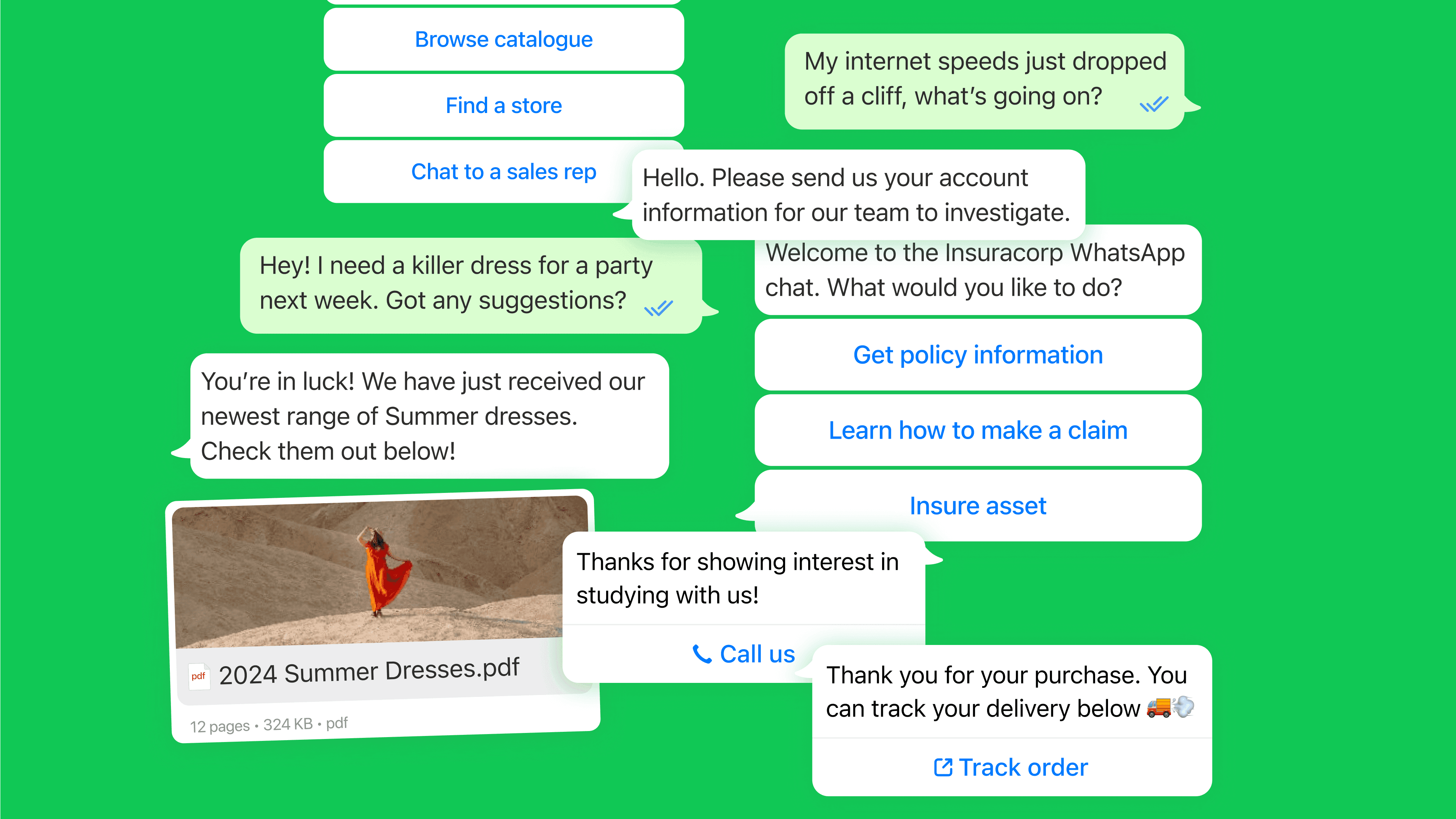
Cue's WhatsApp Business API integration allows you to move beyond simple text. You can deploy rich media interactions, including images, location sharing, and interactive buttons that simplify complex choices for your users. The most significant advantage is the persistent thread. Unlike web-based chat that resets when a session expires, WhatsApp stores the entire history. This continuity builds long-term customer trust. You are no longer a faceless ticket number; you are a reliable contact in their pocket. This persistence ensures that your brand remains top-of-mind long after the initial query is resolved.
Leveraging the WhatsApp Business API
You cannot scale a global support operation on the standard WhatsApp Business app. You need the API to handle high inbound volumes and integrate multiple agent seats. Cue simplifies this transition by supporting the WhatsApp Business API verification process, helping you meet Meta's requirements and build trust with customers on the platform. This badge validates your brand and reassures users that their data is secure. You also gain the ability to send proactive broadcasts. Instead of waiting for a complaint, you can nudge quiet leads with personalised updates. You turn your support tool into a proactive growth engine that drives revenue while reducing the strain on your human staff.
Bringing Channels Together in Cue's Omnichannel Inbox
Frustration peaks when a customer has to repeat their problem to three different people. You can eliminate this pain point using Cue's omnichannel inbox. This tool aggregates messages from WhatsApp, Facebook Messenger, and Instagram into one high-performance interface. If a conversation starts on social media and migrates to WhatsApp, the context follows. You avoid the "broken record" effect that destroys customer loyalty. A unified view ensures your team never misses a high-value conversation.
Executing the Deployment: From Training to Human-Agent Handoff
You don't simply flip a switch and walk away from your support desk. Executing a high-performance deployment is a controlled evolution that protects your customer experience while you scale. Start with a controlled rollout where your team reviews and refines AI responses before they reach customers, building confidence in your automation before scaling. This process is the most effective way to ensure accuracy against your Source of Truth before a single automated word reaches a customer.
Set up escalation triggers within Cue's workflow builder to catch frustration or confusion, Cue's AI Agents then handoff to a live agent. This proactive detection prevents the "AI loop" where users feel trapped in repetitive cycles. You must train your human agents to view these tools as high-speed assistants rather than replacements. When your team understands that the AI handles the 80% of repetitive, low-value queries, they can focus their energy on the complex, high-value conversations that drive loyalty. Every rejected AI answer becomes a training point, creating a feedback loop that sharpens your system's precision over time.
The Art of the Clean Handoff
Frustration disappears when the transition from bot to human is seamless. When an escalation trigger or complex query requires a person, Cue's software alerts your team and provides the full chat transcript. Your agent never has to ask the customer to repeat their problem. This collaborative approach ensures that even the most difficult cases are handled with total brand consistency. You protect your reputation by ensuring no customer is ever left waiting in a dead-end conversation.
Beta Testing and Iteration
Run a 14-day trial with a small segment of your traffic to catch edge cases before a full rollout. This period allows you to identify regional slang or specific product questions that your initial knowledge base audit might have missed. Monitor your "Deflection Rate" as the primary KPI for your implementation success. Iteration is the relentless process of refining your data to move from 50% automation to a 95% success rate. You can start your deployment with Cue to begin optimising your handoff triggers and reclaiming your team's time today. Implementing your AI Agents is not a one-time event; it is a commitment to continuous improvement.
Scaling Your Success: Measuring ROI with Cue's Analytics
How do you know if your deployment is actually delivering results? You must track "Cost Per Interaction" to visualise the immediate relief on your bottom line. In 2026, an AI-resolved ticket costs about £0.9, while a human agent interaction averages £11. This contrast proves the fiscal necessity of your strategy. According to Gartner, Conversational AI is projected to reduce global contact centre labour costs by £58 billion this year alone. Monitor your Average Resolution Time (ART) to quantify the speed of your new AI-first support system. You aren't just saving money; you're reclaiming thousands of hours of team productivity.
Identifying knowledge gaps is simple with Cue's reporting dashboard. If a specific query consistently requires a person, your knowledge base has a gap that needs closing. You must refine your "Source of Truth" to handle these outliers and reduce friction. This is the final stage of implementing AI chatbots for customer service successfully. You move from a broad deployment to a precision-tuned engine that handles 80% of routine tasks. Scale your capabilities by integrating Cue's AI Agents with your CRM. This enables hyper-personalisation, allowing the AI to retrieve past interaction data and purchase history to provide a tailored experience for every user.
Visualising Support Performance
Spotting volume spikes is easier when you utilise real-time analytics. You can see exactly when a product launch or service outage starts to strain your resources. Use this data to justify further automation investments to your stakeholders with concrete proof. When you can demonstrate that 80% of routine inquiries are fully automated, the case for expansion becomes undeniable. You transform from a reactive manager into a proactive strategist who controls the narrative of customer satisfaction.
Continuous Growth and Integration
Move beyond basic support and use your chatbot for high-value tasks like lead qualification and appointment booking. Connect Cue to your existing systems to allow the AI to surface order statuses and account details, reducing the need for human involvement on routine queries. This deep integration turns your service channel into a proactive growth engine that identifies potential issues before the customer even notices. When you master AI Agents for customer service, you unlock a scalable future. Ready to transform your service? See how Cue's AI Agents can automate up to 80% of your tickets.
Building Your High-Performance Support Future
You now possess the strategic blueprint to move from a reactive support desk to a proactive growth engine. By auditing your knowledge base and being available on multiple channels, you ensure your brand is available 24/7 wherever your customers are. You don't need to struggle with complex software when you understand how to implement AI chatbots for customer service using a phased, data-first approach. Testing your AI Agents before launch allows you to refine your automation until it meets your highest performance standards.
You can join the ranks of market leaders who see 80% of enquiries automated through Cue's technology. As a verified WhatsApp Business API partner, Cue allows for smart messaging on the world's biggest messaging app. Cue also provides a unified inbox that brings all your customer interactions into one controlled environment. You are ready to eliminate the pressure of high inbound volumes and replace it with a scalable, analytical success story. Automate your support today with Cue's AI Agents and start elevating your customer journey. You have the tools to build a service environment that is proactive, personal, and perfectly timed.
Frequently asked questions
Do I need a developer to set up Cue's AI Agents?
Can an AI chatbot really handle complex customer complaints?
How long does it take to train an AI chatbot on my business data?
What happens if the AI chatbot gives the wrong information to a customer?
Is my customer data safe when using AI customer service tools?
Which channels should I automate first: Email, Web Chat, or WhatsApp?
How do I measure the ROI of my AI chatbot implementation?
About the author

Kirsten Gentle
Performance Manager
Kirsten Gentle is fascinated by how customer service actually works once real conversations start arriving. At Cue, she works closely with service teams across WhatsApp, email and live chat, looking at what changes when a business moves from juggling channels to running them properly. She writes about the practical side: routing, response times and the handovers in between.
Further reading

Omnichannel Chatbots for Mid-Market Sales Conversions (2026)
Five omnichannel chatbot platforms compared on channels, conversion features, pricing, and CRM integration for mid-market teams.
Read the guide

7 Real-World Chatbot Examples for Customer Service
The best customer service chatbots in 2026 are intent-based AI Agents that resolve routine, high-volume queries instantly across WhatsApp, web chat, and Messenger, then hand complex cases to a human with full context.
Read the guide
10 WhatsApp chatbot and template ideas for 2025
In this blog we explore 10 ways for businesses to use WhatsApp chatbots and templates in 2024.
Read the guide
