
Last updated
Kirsten Gentle
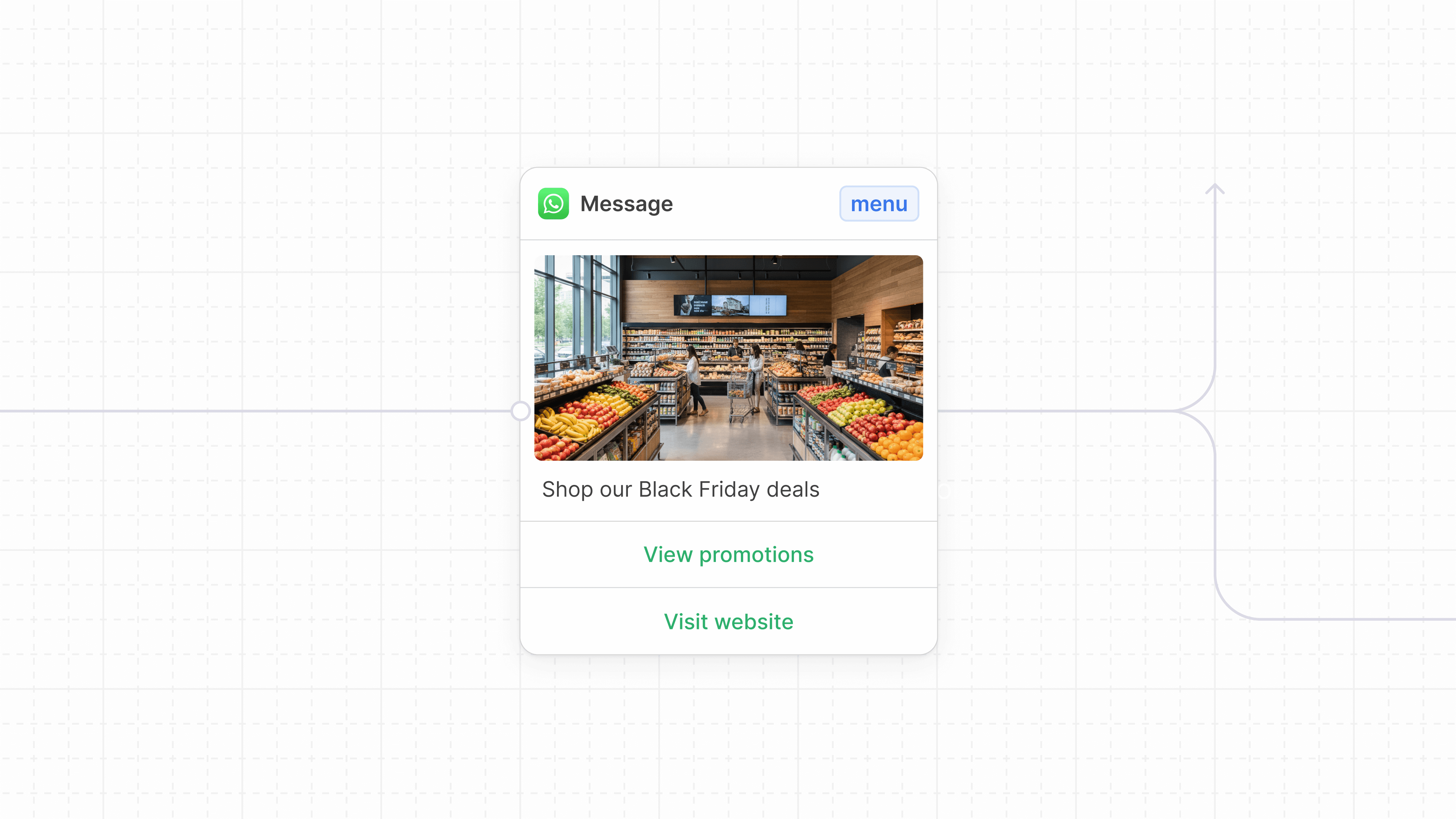

Black Friday 2026 falls on Friday 27 November, with Cyber Monday on Monday 30 November. If you plan to run it on WhatsApp, the thing that decides whether it works is not your creative. It is preparation. Template approval, opt-in lists and messaging limits all have lead times, and a business that connects WhatsApp in November expecting to message its whole list on Black Friday morning will not be able to.
Start now and you win the day. This guide is the full version of the five steps: grow an opted-in list, warm it up, plan your broadcasts, automate the questions that bury your team, and be ready to convert the moment buyers reply. Each one has a job, and each one is easier to do in October than in the final week.
Why WhatsApp is the channel for Black Friday
WhatsApp messages get opened almost immediately, usually within minutes, which is exactly what a time-sensitive offer needs. While competitors fight over email open rates below 20%, you can reach customers on the channel they already check throughout the day. It is also a two-way channel, so customers can ask a question and buy in the same conversation, which suits a peak built on urgency and fast decisions.
The engagement numbers reported across the industry back this up:
Metric | SMS | ||
|---|---|---|---|
Open rate | 98% | 98% | 20% |
Click-through rate | 15-50% | 10.7% | 1.9% |
Conversion rate | 45-60% | 2-5% | 2-5% |
ROI (per $1 spent) | $90 | N/A | $36 |
A Black Friday campaign by Braineffect reported a 25% conversion rate on WhatsApp. Treat these as directional rather than guaranteed: click-through rates in particular vary widely, with around 15% a realistic baseline for broadcasts and 50% or more possible with tight targeting.
Sources: AiSensy (2025), Wapikit (2024), Gallabox (2024), Cooby (2024). These are aggregated vendor benchmarks, not audited figures.

Start early: the lead times that decide everything
Most of the work that makes a WhatsApp Black Friday campaign land is front-loaded, and most of it is slower than people expect. Working back from 27 November:
When | What | Why this timing |
|---|---|---|
Now to mid-October | Connect your account and integrations, draft and submit templates | Template review can take up to 24 hours each, and a rejection restarts it |
Mid-October | Check your messaging limit and start raising it | New business accounts start at 250 unique recipients per rolling 24 hours, and raising that depends on delivered volume over time |
Late October to mid-November | Build genuine send volume, clean your list, check consent | Quality and delivered volume are what move you up the tiers |
Week of 23 November | Final template checks, staff the inbox | Replies land within seconds of a broadcast |
27 to 30 November | Send |
The setup itself is quick. Connect your WhatsApp Business Platform account through a supported provider, complete a business profile so you look verified, and use Cue’s pre-built integrations to link your e-commerce and CRM systems. The platform scales automatically for peak volume and handles compliance and security. That is a few days of work. The approval and limit-raising around it is what needs weeks, so book that time now.
Step 1: Grow your opted-in list
Every till slip, every checkout, every reply is a chance to grow your list. Consent comes first, always.
A strong, opted-in WhatsApp audience is your most valuable Black Friday asset. Add opt-in points everywhere customers already meet you: your website, checkout, order confirmations and social media. Give people a reason to join, such as early access or an exclusive discount, and use click-to-WhatsApp ads to turn paid reach into conversations you can follow up.
Consent is not optional, and it protects you as much as the customer. In the UK, PECR requires consent for marketing messages, with a narrow soft opt-in for existing customers who bought something similar and were given a way to opt out. In South Africa, POPIA requires consent or an existing-customer relationship, and every message must identify the sender and give a way to stop. A list built from people who never opted in is both a compliance risk and a quality risk, because blocks and reports pull down the quality rating that governs your messaging limit.
Step 2: Warm the list up before the sale
Do not let your Black Friday offer be the first message a contact ever gets from you. A promotion landing cold gets ignored, or worse, blocked, and blocks hurt the quality rating you need intact going into the busiest week of the year.
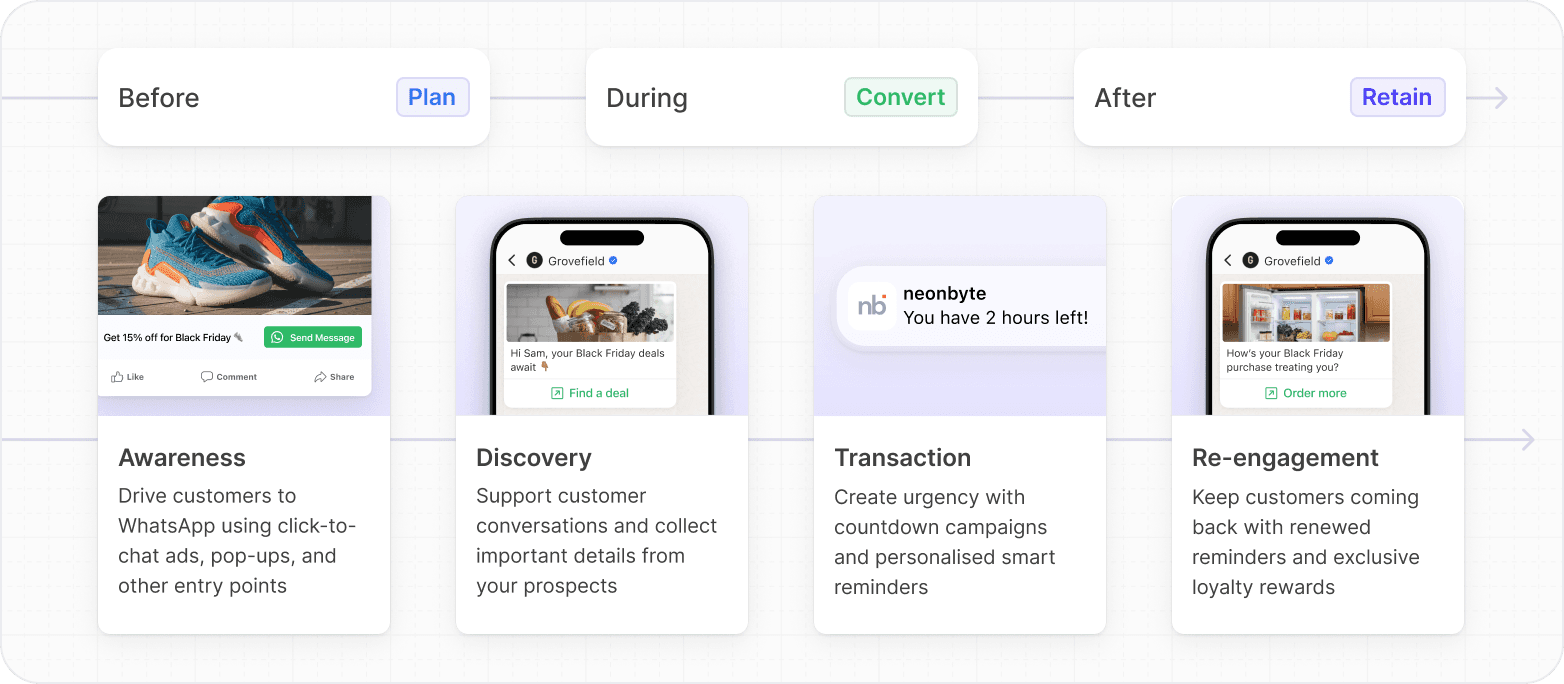
Send something useful in the weeks before. A helpful update, a heads-up on what is coming, early access for your best customers, a countdown or a sneak peek. The point is to be a familiar sender by the time the offer arrives, so the message is opened rather than dismissed. Early access and VIP treatment also reward loyal customers and generate word of mouth that spreads before the sale even starts.
This is where you decide your offer types too, so they are ready to schedule rather than invented on the day:
Offer type | What it does |
|---|---|
Limited-time promos | Create urgency, reward loyalty, re-engage dormant customers |
Flash sales | 24-72 hour offers on specific products or categories |
Free shipping for X hours | Boosts conversions, especially with a cart minimum |
Early access | Gives subscribers and loyalty members first pick of deals |
Countdown timers | Drive urgency and prompt faster decisions |
Step 3: Plan your broadcasts
Teaser, launch, last chance. Write them now, schedule them once. Three planned broadcasts across the weekend do more than a scramble of last-minute sends, and planning them in advance means you can personalise properly rather than blast.
In Cue, broadcasts accept a CSV, XLS or XLSX upload or a Cue contact list. You can personalise with variables and add media, then send immediately or schedule for a specific time, with reporting on sent, delivered and read. Two things are worth planning rather than improvising.
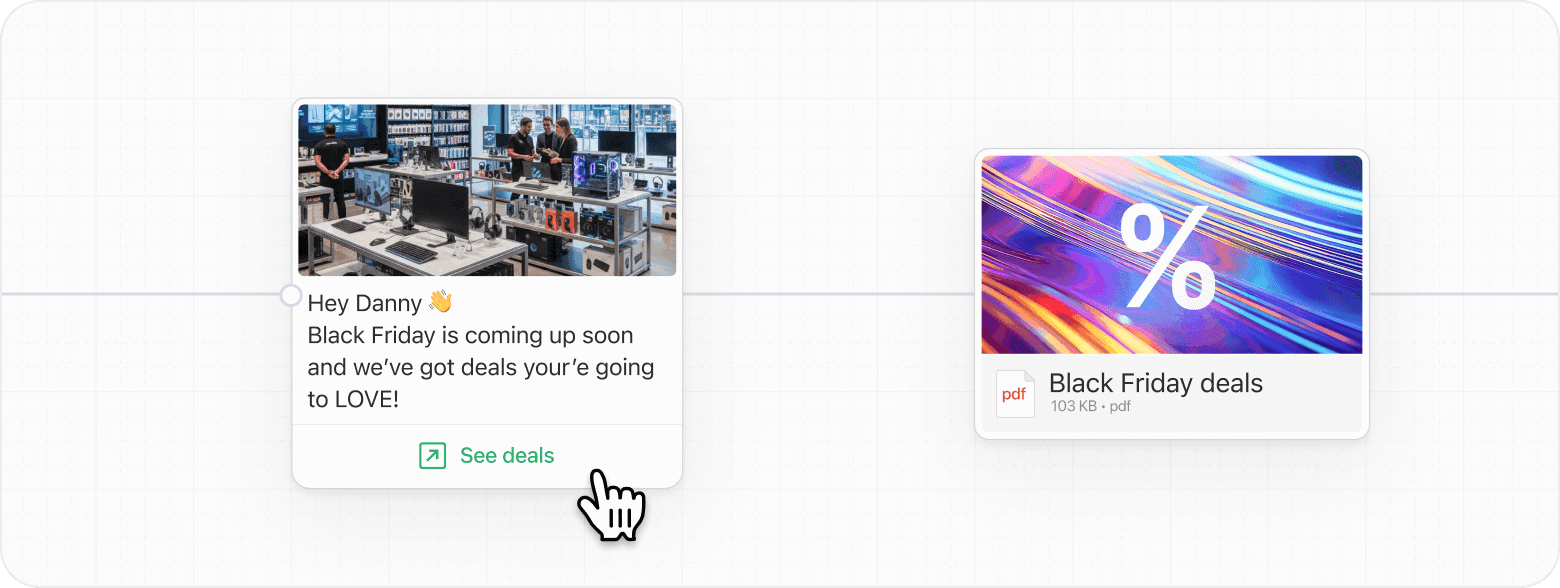
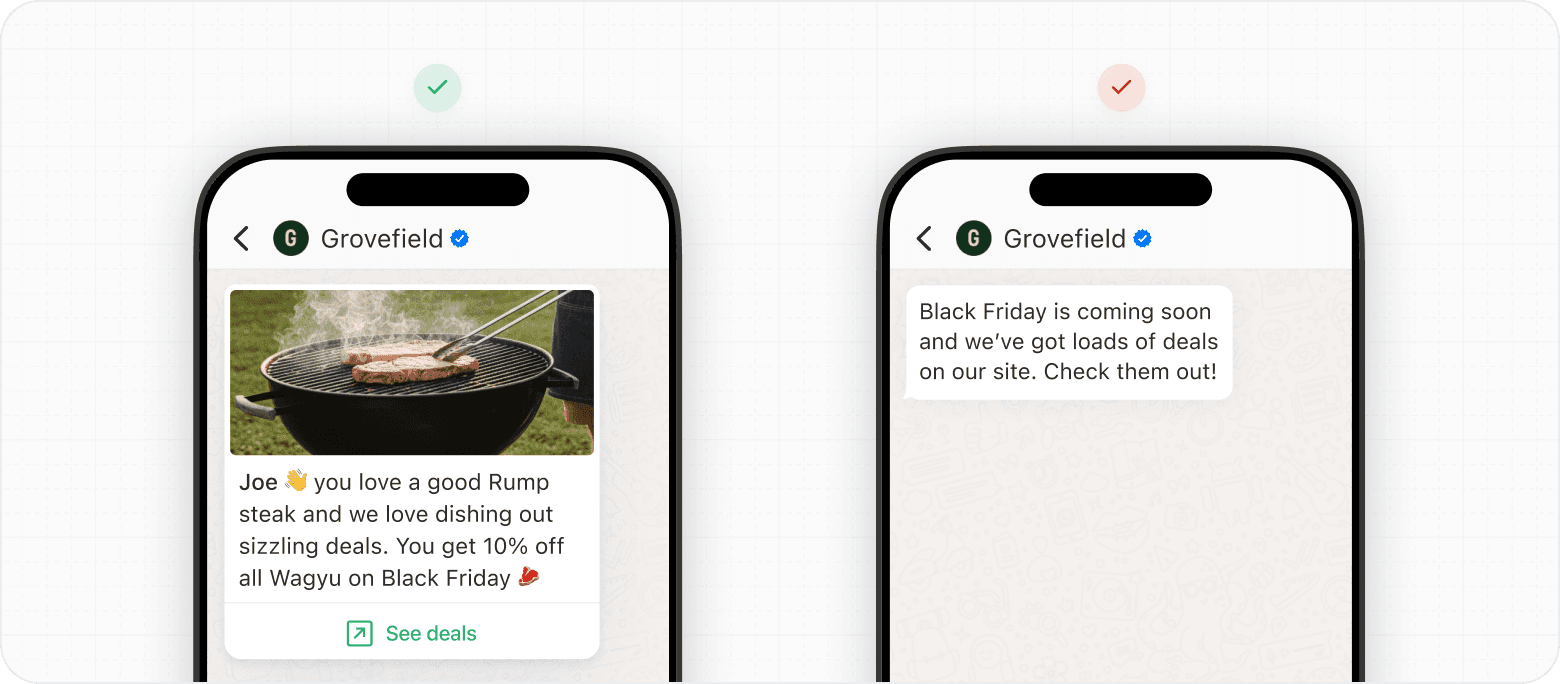
Segment rather than blasting. One message to everyone produces the worst response rate and the highest block rate. Splitting by purchase history or category interest is more work and materially safer for your number. Cue pulls data from your CRM and e-commerce systems, so a broadcast can still use each customer’s name, location and history and feel like a one-to-one message. Dynamic templates take this further, adapting to how a customer responds, so you can retarget people who clicked but did not buy, or remind those who left items in the basket.
Test before the big send. A quick A/B test on a smaller group tells you which message to trust on the day.
Step | Action |
|---|---|
Select template | Choose the message and detail to test |
Define metrics | Set goals like conversions or clicks |
Split audience | Divide your list into similar groups |
Deliver messages | Send each version equally |
Analyse results | Identify the top-performing template |
Remember that any broadcast is a marketing message sent outside the 24-hour window, so it needs an approved template. That is why template drafting sits in October, not November.
Step 4: Automate the FAQs
Stock, sizing, delivery, returns. These are the four questions that bury a team on Black Friday, and almost none of them need a human. Automate them and your people are free for the conversations that actually need judgement.
Cue chatbots and AI Agents handle high volumes of routine queries with 24/7 availability, using natural language processing to understand what a customer wants. They can access order history to give tailored answers, such as order status or processing a return, and they can guide customers to the right offer and help them buy directly in the chat. Anything complex routes to a human, so nothing important gets missed and no customer waits on your busiest day.
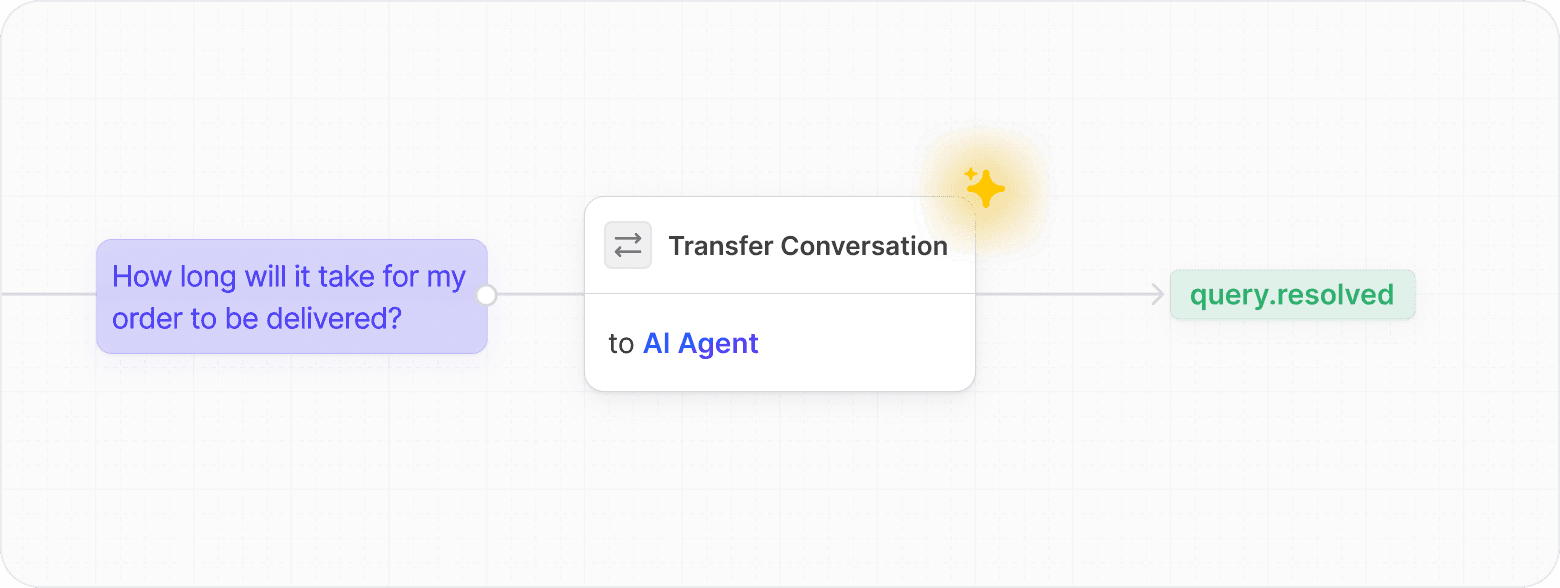
The effect is simple: your team handles far more conversations per hour, routine questions are answered instantly at any hour, and agents spend their time where it changes the outcome. During a peak, that is where automation earns its place.
Step 5: Be ready to convert
Route buyers to a human fast. Speed is the whole advantage. A WhatsApp broadcast is not an email. People reply within seconds, and often it is a buyer with a question standing between them and a purchase. A campaign that lands at 9am with nobody watching the inbox turns your best sales moment into a queue of ignored customers.
Let automation handle the routine replies, and make sure a human is on hand for the ones worth a person. Watch the campaign in real time as it goes out, respond quickly to high-intent replies, and use automated feedback requests afterwards to keep the relationship warm for December.
Track the metrics that tell you what to do next:
KPI | Description |
|---|---|
Avg resolution time | Time it takes to resolve a customer issue. |
Click-through rate (CTR) | Percentage of recipients who clicked a link. |
Open rate | Percentage of messages opened by recipients. |
Unsubscribe rate | Percentage of recipients who opted out. |
One warning for the week itself. Quality rating draws on your last seven days, including blocks, reports, mutes and archives. A badly targeted send in the last week of November can cut your messaging limit going into December, the worst possible month to lose capacity. Send to people who opted in, keep the offer relevant, and resist repeating the same message across the weekend.
Your Black Friday action plan
Use this to work back from 27 November 2026:
Preparation (September to October): review last year’s results, set goals for sales and engagement, connect Cue to your e-commerce and CRM, build and segment your opted-in list, and draft and submit templates with time to resubmit if any are rejected. Check your messaging limit and start raising it.
Campaign build (early November): finalise creatives and templates, set up AI Agents for the routine questions, write your teaser, launch and last-chance broadcasts, and schedule them.
Execution (Black Friday week, from 23 November): send your planned broadcasts, monitor KPIs in real time, and staff the inbox so buyers reach a human fast.
Optimisation (post-event): review results, gather feedback, and carry the warmed-up list into December and beyond.
Get a free demo with Cue
The work that decides your Black Friday is mostly done before November: templates approved, limits raised, list grown and warmed, questions automated and the inbox ready. Cue gives you the tools to get it in place. Book a free demo to see how broadcasts, chatbots and AI Agents work together, and get your setup ready before the approval window closes.
Frequently asked questions
What makes WhatsApp marketing so effective for Black Friday?
When should I start preparing my WhatsApp Black Friday campaign?
How do Cue chatbots improve agent productivity?
Do I need opt-in to send WhatsApp marketing messages?
Do I need technical skills to use Cue for Black Friday WhatsApp marketing?
About the author

Kirsten Gentle
Performance Manager
Kirsten Gentle is fascinated by how customer service actually works once real conversations start arriving. At Cue, she works closely with service teams across WhatsApp, email and live chat, looking at what changes when a business moves from juggling channels to running them properly. She writes about the practical side: routing, response times and the handovers in between.
