
Last updated
Grace Cowan
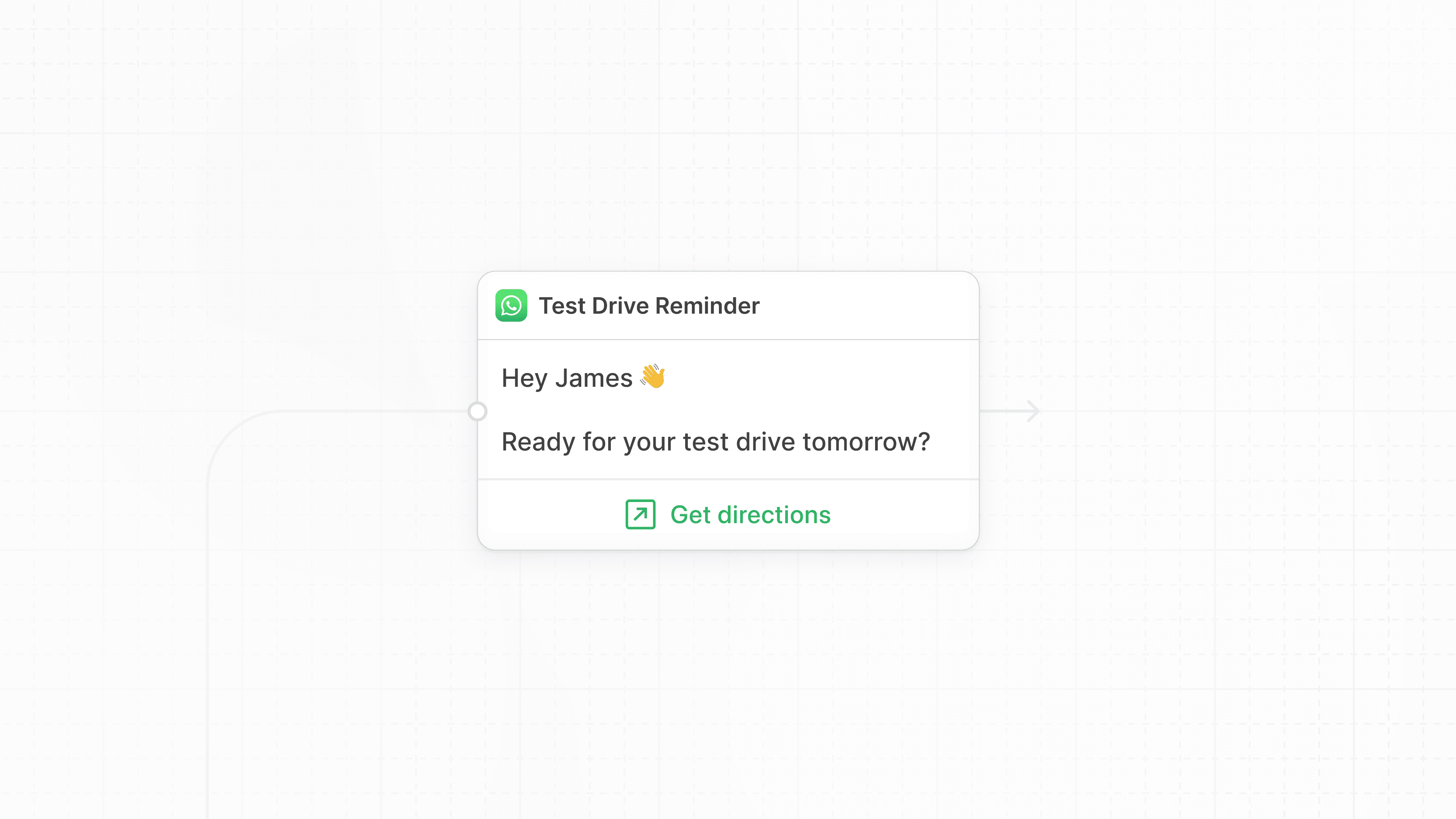

A service bay booked for 9am that no-one turns up for doesn’t just sit empty. The advisor who confirmed the booking the week before has already spent time on it, the technician scheduled against it has a gap in their day, and the slot that could have gone to another customer is gone. A single no-show costs more than the missed job, it costs the admin time already spent setting it up and the opportunity cost of what could have filled it instead.
Most dealerships still confirm appointments the way they always have: a reminder call the day before, sometimes a follow-up text. Calls go to voicemail. Texts get read late, sitting alongside marketing messages the customer has learned to ignore. WhatsApp reminders solve a narrower problem than a full reminder call, but they solve it reliably: the message gets seen, usually within minutes rather than by the end of the day.
What a WhatsApp reminder sequence actually looks like
A typical sequence isn’t a single message. It’s two, spaced a few days apart:
Three days before:
“Hi James, this is a reminder that your Golf is booked in for a service on Thursday 28th at 9:00am at Meridian Motors. Reply YES to confirm or CHANGE if you need to move it.”
The morning of the appointment:
“Morning James, just confirming your 9:00am service today. See you shortly.”
The first message gives the customer time to rearrange if the date no longer works, which is when most genuine rescheduling happens. The second is a same-day nudge, short enough that it doesn’t read as a second full reminder. Dealerships that send only a single reminder tend to catch fewer rearrangements, since a customer who realises on the morning itself that they can’t make it is more likely to simply not turn up than to message back.
What this frees up for the service team
The direct effect is fewer no-shows. The indirect effect, and often the bigger one, is time: an advisor who no longer needs to work through a call list confirming tomorrow’s bookings can spend that time with customers already at the dealership, or on the aftersales work covered in WhatsApp for automotive aftersales.
Reminders are usually the easiest use case to get running, because the appointment already exists in the DMS. The reminder simply reaches the customer through a channel they’re more likely to see, rather than requiring a new booking process. If your DMS is Keyloop, Pinewood, MGS or Dragon 2000, see which dealer management systems does Cue integrate with for how that connection works.
Where a reminder-only approach falls short
A reminder message that only confirms the appointment, without an easy way to reschedule, tends to produce a specific failure pattern: the customer who can’t make it either doesn’t reply at all, or replies with a question the advisor then has to answer manually anyway. Giving a direct CHANGE option in the message itself, rather than asking the customer to call in, is what keeps the rescheduling load off the phone rather than just moving it from a missed appointment to a missed call.
Reminders as the start of a wider conversation
A reminder is often the first WhatsApp message a customer receives from a dealership, and it sets the tone for everything after it. Dealerships that start with reminders and later add post-service feedback surveys over the same channel have seen survey completion move from around 30% to as high as 85%, because the customer is already used to seeing and responding to messages from the dealership by the time the survey arrives. See how dealerships boost NPS, CSI and survey completion with WhatsApp for the fuller picture.
Reminders are a low-effort, low-risk starting point: they don’t change how a service department operates day to day, just how the confirmation reaches the customer.
Frequently asked questions
How many reminder messages should we send before an appointment?
What happens if a customer doesn’t respond to a reminder at all?
Do reminders work for walk-in or same-day bookings, not just pre-booked appointments?
Does sending a reminder count as marketing under WhatsApp’s rules?
Will customers get reminders for every type of visit, or only services?
About the author

Grace Cowan
Head of Marketing
Grace is Head of Marketing at Cue, an omnichannel customer service platform. She works across B2B SaaS growth, customer experience and AI-led service, sharing practical insights on WhatsApp Business, customer communication and the strategies businesses can use to improve service and drive revenue.
Further reading

Which DMS platforms does Cue integrate with?
The dealer management systems Cue integrates with today, and how the integration works for aftersales and service teams.
Read the guide

Dealer group rollout playbook
A practical four-stage playbook for rolling out standardised WhatsApp communication across a multi-site dealer group.
Read the guide
Why marketplace leads go cold before anyone replies
Why leads from AutoTrader, Motors and similar platforms need a fast response, and what that looks like in practice.
Read the guide
