
Last updated
Kirsten Gentle
AI
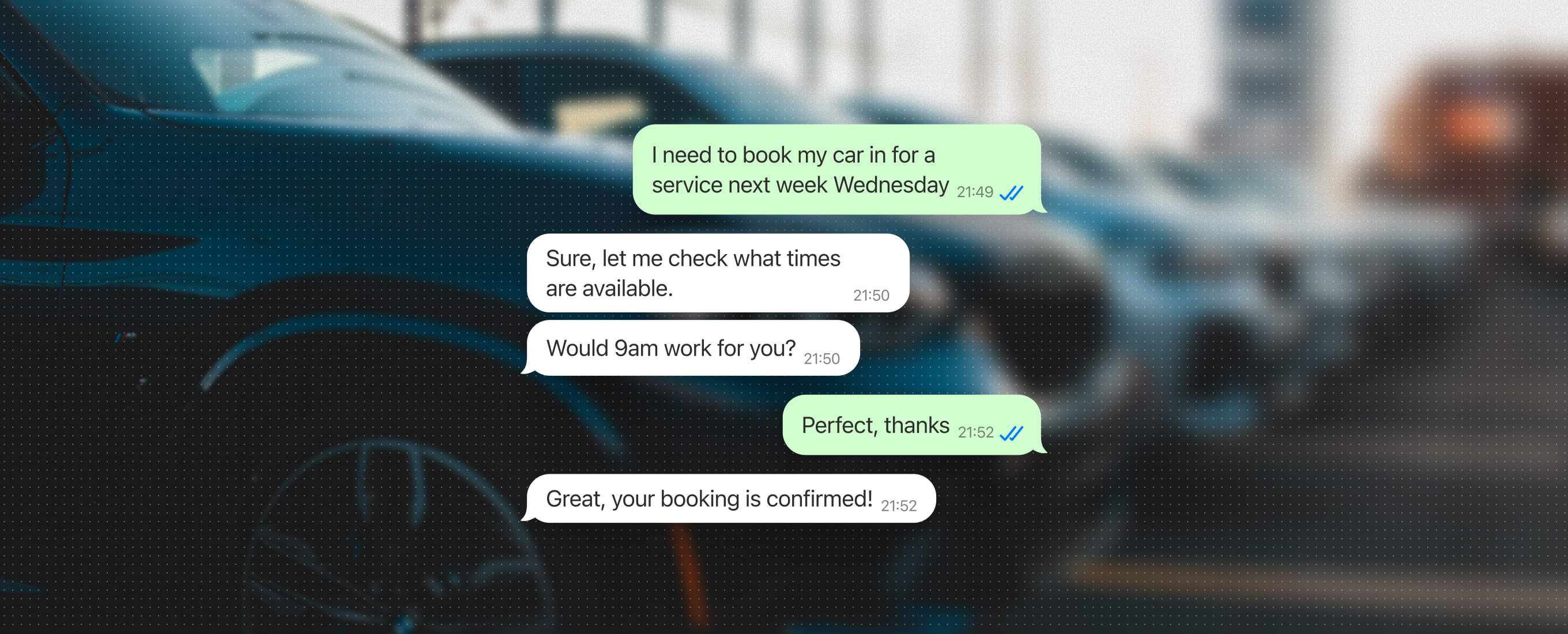

Your customers don’t answer the phone any more. They don’t reply to email. And the SMS reminder you paid to send for next Tuesday’s service slot? It’s sitting unread next to fourteen others.
This is the new reality for car dealerships in 2026, and it is costing real money. Spyne’s 2026 lead response research found that 78% of car buyers choose the first dealership that contacts them, and replying within five minutes makes a dealership 100 times more likely to engage a prospect than waiting 30 minutes. Voicemails, unanswered emails, and ignored SMS reminders aren’t minor inconveniences any more. They are lost deals.
The dealerships winning in 2026 have stopped trying to fix this with more headcount or harder-working teams. They’ve centralised customer communication, moved to a channel customers actually use, WhatsApp, and they’ve layered AI on top so every enquiry, reminder, and survey gets handled instantly across sales, service, and aftersales.
This guide covers what the best AI customer service for car dealerships actually looks like in 2026, including what it does, what it doesn’t, how it integrates with your DMS, and what UK Stellantis dealer Worthing Motors did to lift survey engagement by 55% and earn an extra £5,000 per quarter in manufacturer rebates.
Key takeaways
Buyers reward speed. The dealership that responds first to an enquiry wins a disproportionate share of the deal.
WhatsApp is now the default customer channel. Open rates approach 98% versus around 20% for email, and the AI layer is what makes it scale across sales and aftersales without expanding headcount.
The biggest revenue wins are in aftersales: automated service reminders, CSI and NPS surveys that actually get returned, Vehicle Health Check updates with photos and in-chat approval.
Personal WhatsApp on staff phones is a GDPR or POPIA breach waiting to happen. Moving to the official WhatsApp Business API is non-negotiable.
Implementation is the part most dealerships underestimate. A partner that handles onboarding, training, and DMS integration with you delivers a far better outcome than a self-serve tool you have to configure alone.
What is AI customer service for car dealerships?
AI customer service for car dealerships is the use of artificial intelligence, usually combined with conversational channels like WhatsApp, web chat, and email, to handle, qualify, and route customer enquiries across the sales, service, and aftersales departments of a dealership without needing a human to be the first responder.
In practice, that means:
Answering common sales questions (stock availability, pricing, finance, part-exchange) instantly, day or night
Booking test drives and service appointments against your live calendar
Sending and chasing service reminders, CSI and NPS surveys, recall notifications, and parts-ready alerts
Capturing and qualifying leads from organic and paid channels
Handing the conversation over to a human agent the moment it needs one, with the full chat history attached, so customers never repeat themselves.
The best implementations bring all customer channels, such as WhatsApp, email, and web chat, into a single inbox, and integrate with your DMS so the AI acts on real inventory, service, and customer data rather than generic answers.
Why dealerships can’t ignore AI in 2026
The contactability problem is getting worse
Phone answer rates have been falling steadily for years. Service advisors regularly leave four or five voicemails to chase a single quote approval. Customers no longer trust unknown numbers, and email reply rates for service-related communication sit well below 20%.
WhatsApp closes that gap. Industry data shows WhatsApp messages have open rates around 98% compared with roughly 20% for marketing emails. For dealer aftersales, that translates directly into faster quote approvals, fewer no-shows, and far higher CSI and NPS survey completion rates.
OEM rebate revenue is on the line
For franchised dealers, CSI and NPS scores aren’t a soft metric, they’re tied directly to manufacturer rebate revenue. Stellantis, BMW, Toyota and others run quarterly programmes that reward dealerships for survey completion rates and positive customer feedback. Miss the threshold and you miss the rebate.
This is exactly where Worthing Motors saw the biggest payback. After moving post-service follow-ups from phone to WhatsApp via Cue in September 2025, the Stellantis franchised dealer lifted NPS survey returns by 55%, from 111 returns in Q1 2025 to 173 in Q1 2026, and earned an additional £5,000 in Stellantis rebates per quarter. On dealership margins of 3 to 5%, that’s not a rounding error.
Personal WhatsApp is a compliance fire
Most dealerships in the United Kingdom and South Africa are already using WhatsApp. They’re just doing it informally, with sales executives, service advisors, and aftersales managers running customer conversations through personal WhatsApp accounts on personal phones.
That’s a problem on three fronts:
GDPR and POPIA exposure. Customer data lives outside your business systems, with no audit trail and no way to action a subject access request properly.
Customer history walks out the door. When a staff member leaves, the conversations and the relationships go with them.
Personal numbers get blocked. Meta routinely flags personal accounts running business traffic. Once blocked, you lose the channel.
Moving to the official WhatsApp Business API through a Business Solution Provider like Cue removes all three risks. The data sits inside your business, the conversations are auditable, and the number stays live.
What does AI customer service actually do for a dealership
Aftersales: the highest-volume use case
Aftersales is where AI delivers the fastest ROI for most dealerships because the volume is high and the tasks are repetitive:
Service booking reminders triggered automatically from your DMS, with confirm or rebook options inside the chat
Vehicle Health Check updates with photos and short videos of the work needed, and in-chat approval so service advisors aren’t chasing sign-offs by phone
Quote approvals. The customer sees the cost breakdown, confirms or queries, and an agent picks up only when needed.
Post-service CSI and NPS surveys sent via WhatsApp, with completion rates that outperform SMS and email
Recall and parts-ready notifications that customers actually open and act on
Sales: speed-to-contact wins
The first dealer to respond to a serious enquiry has a structural advantage. AI customer service closes the response gap entirely:
Leads from websites, WhatsApp, email, social, receive an instant first response.
The AI qualifies budget, finance vs cash, part-exchange, timeline, and preferred model before handing off to a salesperson.
Test drives get booked directly in the chat against live calendar availability
Cold leads in your CRM can be re-engaged with a targeted WhatsApp Broadcast at scale
Customer service: fewer phones ringing
The phones that used to ring constantly with questions like “what time do you close?”, “is my car ready?”, or “can I move my booking?” are now managed differently. Those questions get answered instantly by the AI without reaching your team at all. Your service desk reclaims the time and focuses on the conversations that actually need a human.
AI customer service vs traditional dealer communication
Capability | Traditional (phone + email + SMS) | AI customer service (Cue) |
|---|---|---|
First response time | Hours to days | Seconds, 24/7 |
Customer open rate | ~20% (email); call answer rates declining | ~98% (WhatsApp) |
Channel coverage | One at a time | WhatsApp, email, web chat and more in one inbox |
DMS integration | Manual data entry | Keyloop, Pinewood, Evolve, ERIS, etc |
Compliance | Personal WhatsApp = GDPR/POPIA risk | Full audit trail on the Business API |
Handover to agent | Customer repeats themselves | Full chat history attached |
Reporting | Fragmented across tools | Group-wide across every site |
Cost model | Per-seat tools plus headcount | All-inclusive, no per-seat charges |
How it plays out in practice: the Worthing Motors story
Worthing Motors, a Stellantis franchised dealer in the UK, had two problems that will sound familiar to most dealer principals.
First, phone answer rates were falling, which made it difficult for service advisors to reach customers for quote approvals, car collection, and CSI follow-ups. Second, staff had defaulted to using personal WhatsApp accounts to chase customers thus putting sensitive customer data on personal devices and creating real GDPR risk.
Worthing Motors implemented Cue’s WhatsApp Business platform across the aftersales department in September 2025. The setup covered the full post-service customer journey: automated service reminders 24 hours ahead of appointments, post-service NPS surveys via WhatsApp, and Google review prompts.
By the end of Q1 2026, the results were measurable:
55% increase in NPS survey engagement. Survey returns rose from 111 in Q1 2025 to 173 in Q1 2026.
£5,000 additional quarterly Stellantis rebate. This is material on dealership margins of 3 to 5%.
GDPR exposure removed. Customer conversations are now centralised, auditable, and owned by the business.
No workflow disruption. Cue’s onboarding team handled setup and training without changing how the aftersales team worked day to day.
The pattern shows up across other Cue automotive customers. UK dealerships in the Stellantis network saw a 196% increase in survey response rates (from 26% to 77%) and a 14 point lift in NPS after rolling out WhatsApp via Cue. South African auto parts retailer AutoZone lifted overall customer engagement by 13% and cut email and phone interactions by 40% across its network of 200+ stores.
A 5-step checklist for deploying AI without friction
The technology is rarely the reason rollouts fail. It’s usually how the rollout is sequenced. Use this checklist to deploy AI without disrupting your sales or aftersales operation.
Step 1: Audit your lead leakage
Pull your enquiry logs for the past quarter. Where are leads going cold? After hours? Weekend service requests? AutoTrader enquiries on a Friday afternoon? Map the gaps before you design the solution.
Step 2: Define the AI’s guardrails
Decide what the AI can and can’t say. Standard service pricing: yes. Final on-the-road price on a new car: probably not. Discounts beyond a set percent: manager approval required.
Step 3: Connect your DMS
The AI is only as useful as the data it can act on. Cue integrates with Keyloop, Pinewood, etc in the UK, and Evolve and ERIS in South Africa, so service reminders, customer histories, and stock data flow into customer conversations automatically. See the full guide to DMS integration with WhatsApp.
Step 4: Define the handover protocol
Decide when a conversation has to go to a human, such as when finance pre-qualification is complete, a test drive is booked, or a customer asks for the sales manager. Cue’s Omnichannel Inbox shows the full chat history to whoever picks up, so customers never repeat themselves.
Step 5: Re-activate your cold leads
You probably have thousands of contacts in your CRM who went cold. A targeted WhatsApp Broadcast, with proper opt-in, is the fastest way to bring some of them back. Read rates dwarf email, which is why this is usually the first quick win for new Cue customers.
Choosing a partner, not just a platform
The single biggest reason AI rollouts fail at dealerships is that the platform got bought but nobody owned the implementation. Self-serve tools work great in theory and stall in practice when no one on the team has the time to configure flows, train staff, and tune the AI’s responses.
Cue’s model is built around that reality. Every customer gets:
A dedicated onboarding team that supports the WhatsApp Business API setup and DMS integration
Custom flows built around your existing workflow, not a template forced on top of it
Customer support reps who can assist with any queries and requests
Pricing is transparent and inclusive, with no per-seat charges. Whether your aftersales team is two advisors or twenty, the platform doesn’t get more expensive as you grow.
Closing
In 2026, the dealerships that win aren’t the ones with the biggest teams or the most expensive ad spend. They’re the ones who respond first, follow up automatically, and make it impossible for customers to slip through the cracks.
AI customer service is the layer that makes that possible across sales, service, and aftersales, on the channel your customers actually use. Cue’s AI Agents, Omnichannel Inbox, and WhatsApp Business API give your team the platform to compete in a market that no longer waits.
Book a demo of Cue to see how it would work for your dealership.
Frequently asked questions
Is using WhatsApp for car sales compliant with GDPR and POPIA?
Can AI customer service integrate with Keyloop, Pinewood, or other dealer management systems?
Will an AI agent sound robotic for a premium or luxury brand?
What’s the ROI of using AI for car dealership lead qualification and aftersales?
How do I stop staff from using personal WhatsApp with customers?
What happens when the AI can’t answer a customer question?
How long does it take to implement Cue at a dealership?
Do I need to replace my CRM or DMS to use Cue?
About the author

Kirsten Gentle
Performance Manager
Kirsten Gentle is fascinated by how customer service actually works once real conversations start arriving. At Cue, she works closely with service teams across WhatsApp, email and live chat, looking at what changes when a business moves from juggling channels to running them properly. She writes about the practical side: routing, response times and the handovers in between.
Further reading

Which DMS platforms does Cue integrate with?
The dealer management systems Cue integrates with today, and how the integration works for aftersales and service teams.
Read the guide

Dealer group rollout playbook
A practical four-stage playbook for rolling out standardised WhatsApp communication across a multi-site dealer group.
Read the guide
Why marketplace leads go cold before anyone replies
Why leads from AutoTrader, Motors and similar platforms need a fast response, and what that looks like in practice.
Read the guide
