
Last updated
Grace Cowan
Alternatives

Most people looking for an Intercom alternative are not unhappy with the product. They are unhappy with the bill, or with how hard the bill is to predict once AI resolution pricing is in the mix.
This comparison covers what Intercom costs now, what the main alternatives cost, and which kind of team each one suits. Cue is one of the options listed. You should know that up front, and you should also know that the last section says plainly who Cue is built for, which is a shorter list than the others.
All prices were read from each vendor's own pricing page in September 2026. Currencies are as each vendor displayed them to a UK visitor. Software pricing moves, so check before you commit.
What Intercom actually costs in 2026
Intercom prices per seat, then charges separately for AI.
Plan | Price per seat, per month, billed annually |
|---|---|
Essential | US$29 |
Advanced | US$85 |
Expert | US$132 |
A minimum of one full seat applies. Copilot, the agent-facing assistant, is US$29 per user per month on annual billing.
The part that changes the maths is Fin, Intercom's AI agent, priced at US$0.99 per outcome. Fin can also be bought on its own, without Intercom seats.
An outcome is not the same as a conversation, and the distinction is where budgets go wrong. Intercom counts an outcome when the customer confirms their question was resolved, when they do not ask for further help after Fin's response, or when Fin completes a defined procedure including a handoff. Importantly, you are charged at most once per conversation, even if Fin answers several questions within it.
So a support desk handling 5,000 conversations a month, with Fin resolving half of them, is looking at roughly US$2,475 in outcome charges on top of seats. Whether that is good value depends entirely on what those 2,500 conversations would have cost in agent time. For some teams it is obviously cheaper. For others, particularly those with lower-cost support teams or lower conversation volumes, it is not.
That calculation, rather than the seat price, is usually what sends people looking.
Pick the category before you pick the tool
A few of the tools below are not really Intercom alternatives so much as different categories that Intercom customers end up considering. That is deliberate, and it is the first decision to make.
If your actual problem is that you need ticketing depth, reporting and process control, a shared inbox tool will frustrate you inside a month. If your problem is that a small team needs to answer messages together quickly, a full service suite will feel like administrative overhead you did not ask for. Most bad software decisions in this category are category errors rather than product errors, and they are expensive because you only find out after migrating.
So before comparing prices, decide which of these describes you: an established service operation, a small team working from a shared inbox, a messaging-led business, or an ecommerce brand. The list below is grouped that way rather than ranked.
The alternatives, and what each one costs
Entry prices are the lowest paid tier as displayed on each vendor's own pricing page in September 2026.
Tool | Entry price | Built for | Worth knowing |
|---|---|---|---|
Service suites | |||
Zendesk | Support Team €19 per agent/month | Established service operations needing ticketing depth, reporting and process control | Completed its acquisition of Forethought on 26 March 2026, so its AI offer is changing |
Freshdesk Omni | £25 per agent/month annually | Teams wanting a suite at a lower entry price than Zendesk | Freshworks sells several products under similar names, so check which one a quote refers to |
HubSpot Service Hub | Starter from £7 per seat/month annually | Teams already using HubSpot for CRM or marketing | Professional and Enterprise carry one-off onboarding fees of £1,310 and £3,050 |
Shared inbox and collaboration | |||
Front | Starter US$25 per seat/month, up to 10 seats | Teams who work from a shared mailbox and collaborate on replies | WhatsApp is available on Professional and Enterprise. Front states it bills Meta's WhatsApp costs plus a 20% administration fee |
Help Scout | Standard US$25 per user/month | Small support teams wanting simplicity over configuration | Free tier up to five users |
Missive | Starter US$14 per user/month, up to 5 | Small teams wanting inbox and internal chat together | The cheapest entry point in this list |
Live chat and SMB AI | |||
Crisp | Essentials £95 per workspace/month, 10 seats | Smaller teams who would rather pay per workspace than per seat | Workspace pricing rather than per-seat changes the maths for larger teams |
Tidio | Starter US$24.17/month, 100 billable conversations | Self-serve teams wanting AI-led chat | Priced on conversation volume, so cost scales with demand rather than headcount |
WhatsApp-led messaging | |||
respond.io | Starter US$79/month, 5 users | Teams whose primary channel is messaging rather than email | States that WhatsApp fees are not included in any subscription and that it does not add a markup |
Trengo | Boost €299/month | Mid-market teams wanting an omnichannel inbox | Higher entry point than most here |
Wati | Growth £49/month billed annually | WhatsApp-first teams | Additional per-message charges apply on Wati's own rate card |
Cue | Connect £249/month, unlimited seats | WhatsApp-led customer service in the UK and South Africa | Priced per workspace, not per seat, so the bill does not rise as the team grows. See the last section |
Ecommerce | |||
Gorgias | Starter US$40/month, 50 tickets | Shopify and ecommerce brands | Priced on ticket volume, with AI interactions charged separately |
Prices move, and several of these vendors changed theirs during 2026. Check each one before you commit rather than relying on this table alone.
If WhatsApp matters, check the fee structure
This is worth its own section because it is where quotes diverge most and pricing pages explain least.
When you send WhatsApp messages through any platform, there are three separate costs:
Meta's charge, per delivered message, set by category and market.
What your provider charges you for those messages, which may match Meta's rate or exceed it.
The provider's subscription, which is separate from message costs.
Providers handle the middle layer very differently. Front's pricing page states that WhatsApp costs are billed by Meta plus a 20% administration fee. respond.io states that WhatsApp fees are not included in any subscription and that it does not mark up. Wati applies its own rate card, with rates varying by message category. All three are legitimate models, and at volume they produce noticeably different bills.
Three questions to ask any vendor before signing:
Do you charge Meta's rate, or your own?
If it is your own, how does it compare for my markets and my message categories?
Is there a platform fee on top of message costs, and what does it cover?
If WhatsApp is going to be a main channel rather than an add-on, the answers matter more than the seat price.
How to actually choose
Four things decide this, and none of them is the headline price.
Seats or conversations. Seat pricing suits teams with a stable headcount and variable volume. Conversation or workspace pricing suits the reverse. A ten-agent team handling low volume and a three-agent team handling high volume should not pick the same model.
How AI is priced. Per outcome, per seat, per interaction, or included. This is the biggest source of surprise bills, because it is the only line that scales with how well the AI works. Model it against your real conversation volume before you decide.
Whether your main channel is native. A platform where WhatsApp or live chat is a first-party channel behaves differently from one where it arrives through a third-party app. Check which you are getting.
Suite or conversation platform. If you need a customer portal, a public knowledge base, SLA workflows and complex case relationships, you need a service suite. If you need to handle conversations well across a few channels, a suite will be more machinery than you want.
Who Cue is built for
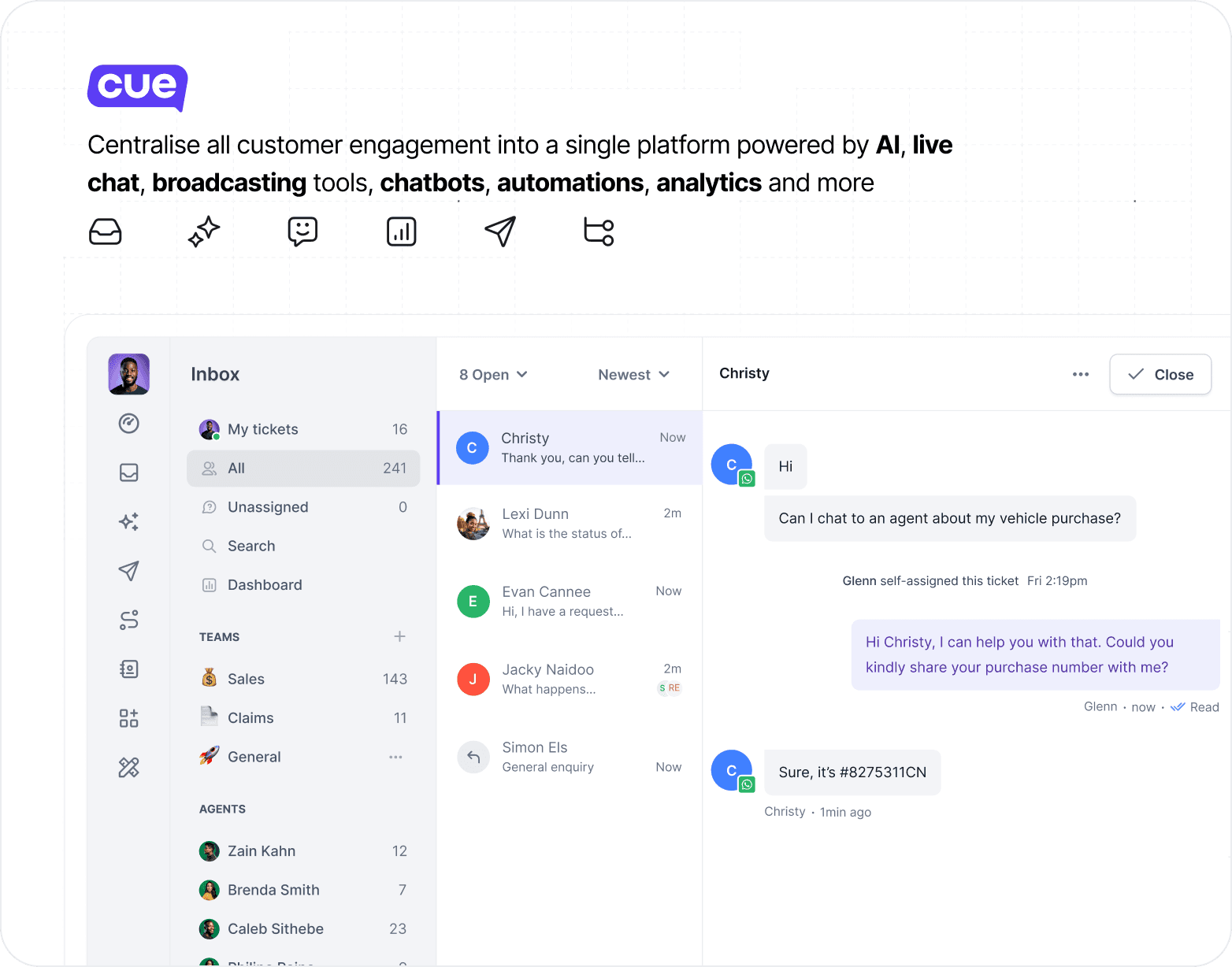
Cue is built for teams whose customers message them, mostly on WhatsApp, in the UK and South Africa. A shared inbox, visual Flows to control the journey, AI Agents that answer from your own approved content, and broadcasts for outbound. It is strongest in automotive and education, where conversation volume is high and the workflows are specific.
Plenty of teams run Cue alongside an existing helpdesk rather than instead of one. That is a normal setup, not a compromise: the helpdesk stays the system of record and Cue handles the conversation layer in front of it.
Where a different category fits better:
If your support model is built around a self-service portal and a public knowledge base, a service suite is the better fit.
If you need a full enterprise contact centre with workforce management and speech analytics, that is a different category of product.
If you are a Shopify-first ecommerce brand, commerce-native tools have a clearer advantage.
If email marketing is the requirement, that is not what Cue is.
One thing worth doing regardless of who you choose: ask every vendor exactly what its AI does on its own, and what has to be built around it. The answer varies enormously across this list, and the marketing language does not distinguish between them.
If WhatsApp-led service in the UK or South Africa is the job, the head-to-head comparison with Intercom goes into more detail than a list like this can.
And if that description fits you, book a demo and we will run it against your channels and your volumes rather than a prepared example. If one of the others above suits you better, we would rather you worked that out now than three months into a migration.
About the author

Grace Cowan
Head of Marketing
Grace is Head of Marketing at Cue, an omnichannel customer service platform. She works across B2B SaaS growth, customer experience and AI-led service, sharing practical insights on WhatsApp Business, customer communication and the strategies businesses can use to improve service and drive revenue.
Further reading

WhatsApp or SMS: how to choose for business messaging
Cost, message length, consent and delivery states compared, without the unsourced open-rate statistics, plus which channel fits which job.
Read the guide
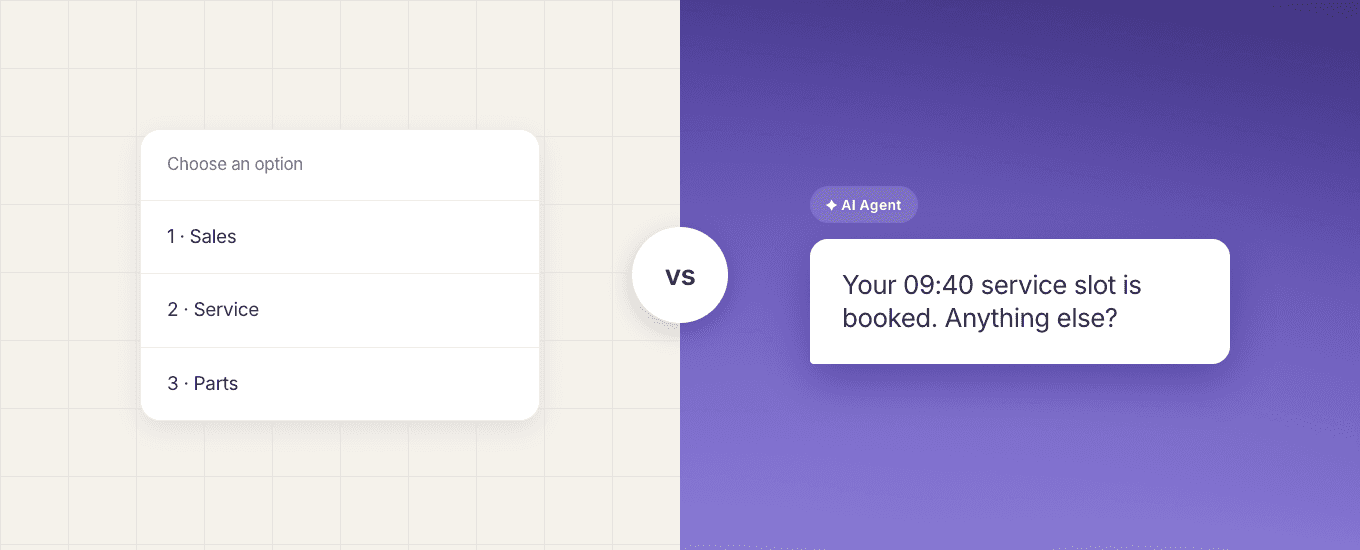
AI agents vs chatbots in automotive customer service
The real difference between a chatbot and an AI agent, and what it means for automotive customer service today.
Read the guide

Fuzey vs Cue: which is the better fit for your dealership?
A fair, fact-checked comparison of Fuzey and Cue for automotive: channels, DMS integration, AI capability, proof and pricing.
Read the guide
