When admissions advisers message applicants from their own phones, the institution can't see what was said, can't search it when someone asks for their data, and loses the conversation when the adviser leaves. If applicants are under 18, there's a safeguarding question too.
The answer isn't to stop using WhatsApp. Applicants reply on it, which is why advisers turned to it in the first place. The answer is to move those conversations onto lines the institution owns, where the team can see them and the history stays put.
This is general information to help you think the problem through. It isn't legal advice.
Why it happens
Advisers using their own WhatsApp aren't trying to get round policy. They do it because:
applicants don't pick up calls from unknown numbers and don't read email quickly
applicants do answer WhatsApp, and quickly
many admissions roles have targets, and some have commission, so advisers use whatever gets a reply
there's no official WhatsApp channel, or the official one is a single shared phone in the office
It works, until someone asks what was promised to an applicant, an applicant asks for their data, or the adviser leaves and takes three hundred conversations with them.

What UK data protection says
There's no UK rule that bans staff from using WhatsApp, and no rule that bans personal devices outright. What the law does is make the institution responsible for personal data it controls, wherever that data sits.
The Information Commissioner's Office (ICO) is clear on a few points:
Personal devices and private messaging apps aren't usually the right place for this data. In its guidance on subject access requests, the ICO says personal devices and private instant messaging aren't usually appropriate for holding information about customers or contacts, and recommends a clear organisational policy.
Work messages on a personal phone can still be in scope of a subject access request. If an applicant asks for their data and there's good reason to think it's on an adviser's phone, the institution may need to ask the adviser to search it.
Security has to match the risk. UK GDPR Article 32 requires appropriate security for the data being processed (ICO security guidance). Organisations with 250 or more employees must also document all their processing, and data should only be kept as long as it's needed (ICO on storage limitation).
The ICO has acted where this goes wrong. In March 2024 it reprimanded Dover Harbour Board and Kent Police after work information was shared over WhatsApp, and then Telegram, on personal phones without appropriate safeguards or management oversight. That wasn't a ban on WhatsApp. It was about the lack of control.
The ICO's guidance in this area is under review following the Data (Use and Access) Act 2025, so check the current version before you rely on any detail.
When applicants are under 18
Schools, sixth forms and colleges recruiting under-18s have a second set of obligations. In England, Keeping children safe in education 2026, in force from September 2026, says staff behaviour policies should cover the acceptable use of technology and mobile devices, and staff–pupil relationships and communications, including social media.
Private one-to-one WhatsApp threads between an adviser and a 16-year-old, on the adviser's personal phone, are hard to square with that. Conversations held on institution lines, visible to the team, are much easier to defend. KCSIE applies to schools and colleges in England; universities should check their own safeguarding policies.
South Africa: POPIA
In South Africa, POPIA section 19 requires the responsible party to secure personal information in its possession or under its control, by identifying the risks and putting reasonable technical and organisational safeguards in place (POPIA Act). Sections 20 to 22 cover how operators handle the information and what happens when there's a security compromise.
Those duties follow the information, not the handset. Applicant data on an adviser's own phone is still the institution's responsibility. We haven't found an Information Regulator ruling specifically on staff using personal phones or WhatsApp, so treat this as the general rule applied, not a specific ban.
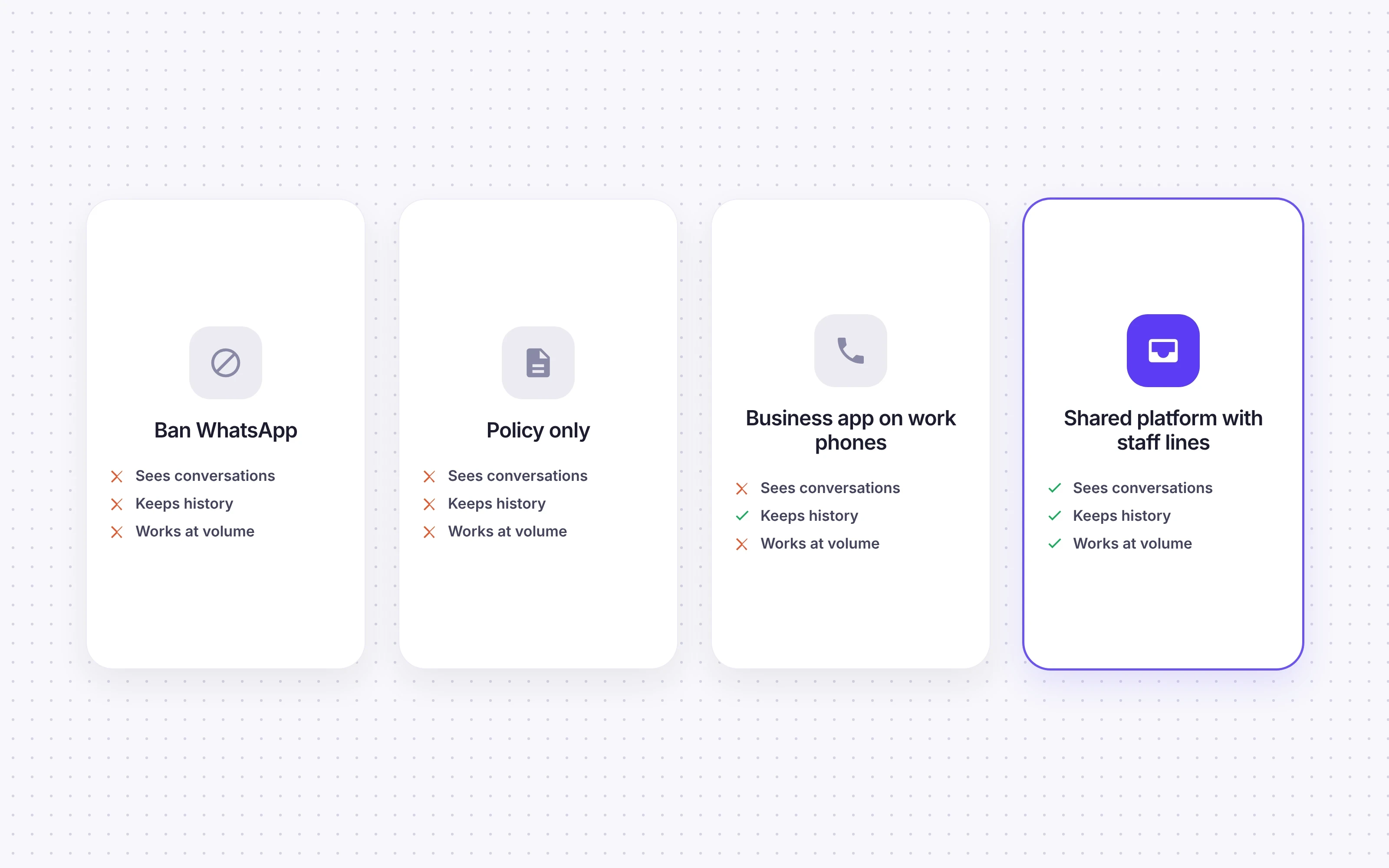
Four ways institutions handle it
Approach | Can the institution see conversations? | Does history stay when someone leaves? | Works at admissions volume? |
|---|---|---|---|
Ban WhatsApp | Not applicable | Not applicable | No: applicants keep messaging, and advisers keep replying |
Policy only, staff keep using their own phones | No | No | Yes, but the risk stays |
WhatsApp Business app on work phones | Partly, if you collect the phones | Only on the device | Limited: built for small teams on a few linked phones |
A shared platform with staff lines | Yes, by role | Yes | Yes |
The first two leave the problem where it is. The third helps a small team but doesn't scale to an admissions office in peak season. For the general case outside education, see how to get customer WhatsApp conversations off personal phones.
What a shared platform changes
In Cue, admissions staff get their own line inside the platform. Applicants still message on WhatsApp, and advisers still reply quickly, but the conversation stays with the institution, sits against the applicant's record and is visible to the team.

That changes the questions above:
Oversight: supervisors can see conversations and who's handling them.
Subject access requests: the conversation is in one system the institution controls.
Leavers: when an adviser leaves, their conversations stay and can be reassigned.
Access: what each person can see is controlled by role, and Cue supports single sign-on with Google and Microsoft Entra ID.
South African education provider Richfield gave its admissions agents dedicated lines in this way, connected to its CRM, so conversations stopped living on personal phones. The same move to WhatsApp lifted its response rates sevenfold compared with phoning prospective students. Read the Richfield story.
A short checklist
WhatsApp lines are owned by the institution, not individuals
Applicant conversations sit in one system, against the applicant's record
Access is set by role, and removed when someone leaves
You know how long applicant conversations are kept, and why
A written staff policy says which channels to use and which not to
For under-18s, the policy matches your safeguarding obligations
If you're moving applicant messages off personal phones and SMS at the same time, our phase one plan sets out what to move first.
If several of those are a "no" today, see how admissions teams give staff their own line in Cue, or book a demo.