An admissions team doesn't need a big project to start using WhatsApp. It needs four or five messages moved off the channels applicants have stopped reading, a shared inbox for the replies, and a way to see whether it worked.
That's phase one. Pick the messages applicants most need to see, rebuild them as approved WhatsApp templates, keep SMS or email as a fallback for anyone not on WhatsApp, and measure the before and after. University College Birmingham did exactly this in June 2025, and conversion from its Higher Education winter events rose from 41% to 62% the following year.
This plan works the same way in the UK and South Africa. The starting point, the sign-off and the law differ, and we've called those out as we go.
Why institutions make the move
The trigger is applicants not responding on the channel the institution uses.
In the UK, that channel can be SMS or email sent from a list. University College Birmingham's SMS service had three problems. It showed no delivery or read data, it couldn't reach applicants on WhatsApp, and it only sent plain text.
In South Africa, the starting point can be the phone. At Richfield, prospective students left their details through SMS or Facebook and an adviser phoned them back. Many didn't answer. Richfield moved that follow-up to WhatsApp and response rates rose sevenfold.
For a full channel comparison, including cost and reach, see WhatsApp vs SMS.
What to move first
Start with the messages tied to a date or a decision. They're the ones where a missed message costs you an applicant.
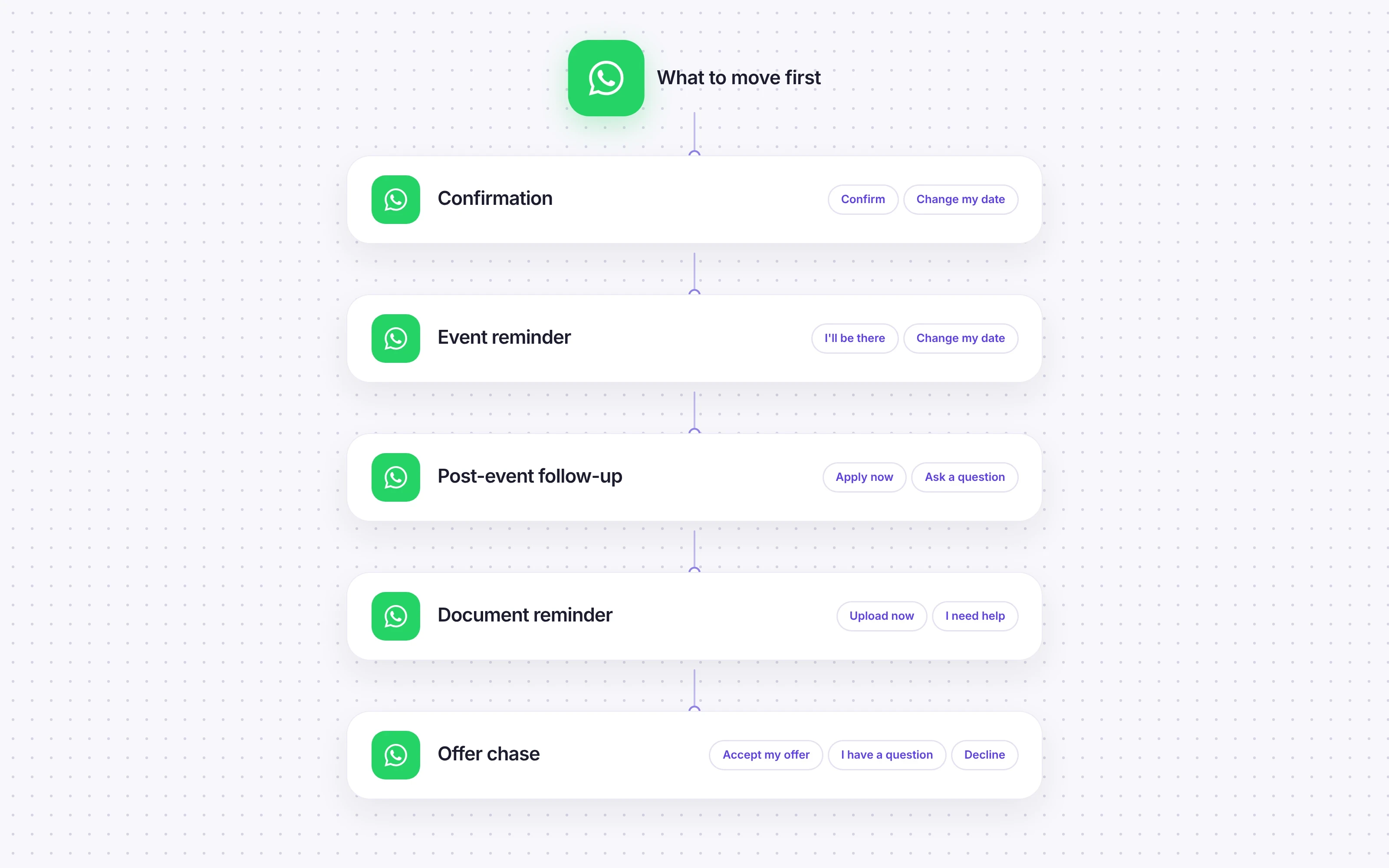
Message | Where it goes today | WhatsApp version | Reply buttons |
|---|---|---|---|
Enquiry or registration confirmation | Email, SMS or nothing | Sent straight away, with what happens next | "Thanks" / "I have a question" |
Open day or campus visit reminder | Email or SMS | The day before, with time, directions and a short video | "I'll be there" / "Change my date" |
Post-event follow-up | Email, a week later | Within a day, with a link to apply | "Start my application" / "Ask a question" |
Application or document reminder | Before the deadline, listing what's missing | "Done" / "I need help" | |
Offer chase | Email or a phone call | In the same thread, before the response deadline | "Accept my offer" / "I have a question" / "Decline" |
In South Africa, the document reminder can matter more than the open day, because incomplete applications hold up registration before intake. Swap the order to suit your calendar.
Our open days playbook has the wording for the event messages.
What you need in place before the first send
None of this needs an integration on day one. Several institutions start with a contact list and add a CRM connection later.
A WhatsApp Business Platform account in your institution's name, set up through a provider. Cue is a Meta Business Partner and sets this up with you.
A number for that account that applicants will recognise as yours.
Approved message templates. Messages that start a conversation have to use a template Meta has approved. Meta also places each template in a category, such as Utility or Marketing, and the category affects both the rules and the price.
A contact list with mobile numbers you have a lawful basis to message (more on consent below).
Someone to answer replies. Replies land in a shared inbox, so decide who owns them and during which hours.
A before figure for each message you're moving: sent, delivered, read where you have it, replied, and the outcome (attended, applied, accepted).
Meta charges per delivered template message, with rates by category and country. Its pricing page has the current rates.
Consent when you change channel
Moving a message to WhatsApp doesn't change whether you're allowed to send it. It's worth checking each message against your consent wording before you switch.
Service messages are about something the applicant has already done, such as a booking confirmation, a document reminder or an offer decision. In the UK, the ICO separates administrative and service messages from direct marketing in its guidance on identifying direct marketing. Adding promotional content can change that.
Marketing messages encourage someone to apply, attend or take up an offer they haven't asked about. In the UK, they fall under PECR and UK GDPR. In South Africa, section 69 of POPIA governs unsolicited electronic direct marketing, and the Information Regulator's guidance note on direct marketing sets out how it applies.
Two practical checks:
Read your enquiry and application forms. Consent to marketing by SMS doesn't automatically cover WhatsApp. In the UK, the ICO's guidance on electronic mail marketing says consent should cover the type of message you send, and to ask for each type separately. In South Africa, the Information Regulator's guidance says you must stick to the method of communication the person chose. Update your forms so new applicants can opt in to WhatsApp, and ask existing contacts before you send marketing there.
Give every marketing message an easy way to opt out, and record it.
This isn't legal advice. Your DPO in the UK, or your Information Officer under POPIA, should sign off the approach.
Run both, then switch
Don't turn SMS or email off on day one.

For the first cycle, send the WhatsApp version to applicants with a WhatsApp number and keep the old channel for everyone else. That gives you a like-for-like comparison on the same event or deadline, and it means nobody misses a message while you learn.
Once the WhatsApp numbers hold up across a couple of sends, make WhatsApp the default and keep SMS or email as the fallback for people who aren't on it.
What UCB and Richfield measured
University College Birmingham (UK) replaced its SMS service with Cue in June 2025.

Measure | SMS | Cue and WhatsApp |
|---|---|---|
Higher Education winter event conversion | 41% (2024) | 62% (2025) |
Further Education conversion | 61% | 68% |
Engagement | About 31% | 78% |
Delivery and read rates | Not visible | About 82%, tracked |
Read the University College Birmingham story.
Richfield (South Africa) stopped phoning prospective students who had enquired and followed up on WhatsApp instead.
Measure | Result |
|---|---|
Response rates | Up sevenfold |
Call-to-action rate | Up 65% |
The University of Chichester started with Cue in the same way, with simple outbound messages before anything else.
Across Cue's education customers, WhatsApp messages to applicants see a 98% open rate and an 8% call-to-action rate.
What your DPO or Information Officer and IT team will ask
Expect these questions, and have the answers ready before you go to procurement.
Question | What to check |
|---|---|
Whose account is it? | The WhatsApp Business account should be in the institution's name, not a staff member's or a supplier's |
Where do conversations live? | In Cue, conversations sit on the contact record in a shared inbox, so they stay with the institution when staff move on |
Who can see what? | Access by role, so an adviser sees their queue and a manager sees the team |
How do staff sign in? | Single sign-on with Google or Microsoft Entra ID |
Are staff using personal phones now? | If so, that's a bigger risk than the move itself. See admissions staff on personal WhatsApp |
What's the lawful basis for each message? | Service or marketing, as above |
Phase two
Once phase one is running, the same inbox and templates carry the next steps: asking entry questions in the chat so advisers only speak to eligible applicants, routing by course or campus, AI Agents answering routine questions from your own content, and connecting to your CRM. Our guide to WhatsApp automation for admissions covers that stage.
We've written the phase one messages, and 12 more, in our admissions WhatsApp template pack. To see how institutions in the UK and South Africa run admissions on Cue, visit Cue for education or book a demo.