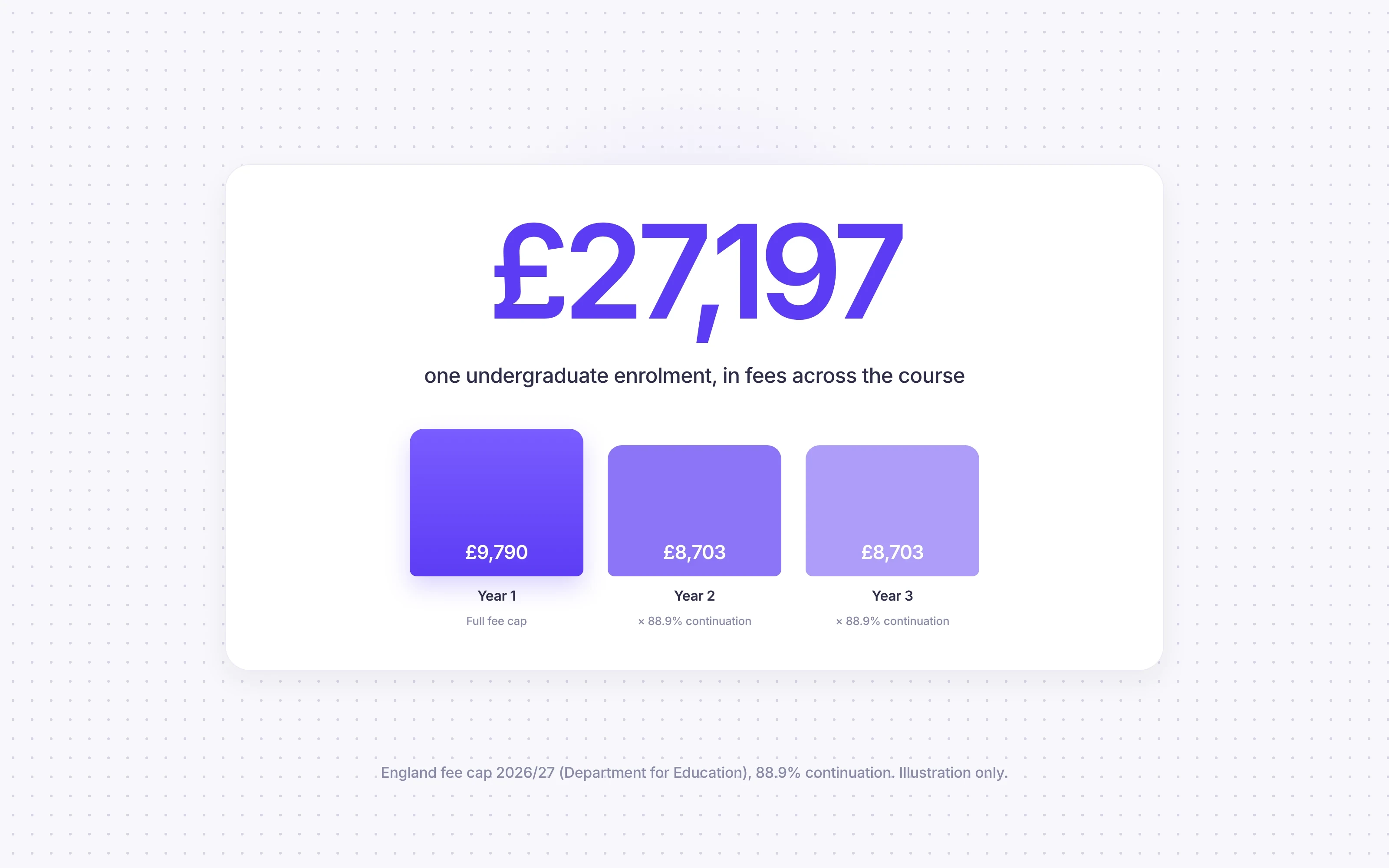
A student who doesn't enrol doesn't cost you one year of fees. They cost you every year they would have studied. On a three-year degree charged at England's 2026/27 fee cap of £9,790, that's £29,370 before you allow for anyone leaving early.
The calculation is simple:
Value of one enrolment = annual fee × (1 + (years − 1) × continuation rate)
The rest of this article explains each part, works it through for a university, an independent school and a South African private college, and shows what a single percentage point of conversion is worth on your own numbers.
Why the loss lasts for the whole course
An empty first-year place doesn't fill itself in second year. The student who didn't start in September is also missing from the second-year cohort, and the third. The gap stays in the numbers until the course ends.

That's why recruitment shortfalls hurt for longer than a bad year of anything else. And it's why the time and money spent converting enquiries is easier to justify than it first looks.
Much of what's published about "lost students" describes withdrawals: people who start and then leave. A missed enrolment is different. It's an applicant who enquired, maybe visited, maybe even received an offer, and never started at all. It sits earlier in the journey, and it's the part admissions teams can do the most about.
The formula, explained
Value of one enrolment = annual fee × (1 + (years − 1) × continuation rate)
Annual fee. What you actually charge and collect for the course. If you run many courses, use a typical figure. A fee cap is a maximum, not an average, and some providers and courses sit below it.
Years. The standard length of the course. Undergraduate degrees typically take three years in England, Wales and Northern Ireland and four in Scotland, according to the British Council.
Continuation rate. The share of students who carry on after the first year. The first year counts in full, because a student who enrols pays for it; later years are reduced by continuation. The Office for Students reported 88.9% continuation for full-time first-degree entrants in England who started in 2020/21. It's a historical figure, so use your own if you have it.
The figure covers fees only. It leaves out accommodation and other income, and it doesn't subtract the cost of teaching. It also isn't a precise refund calculation: as UCAS's student finance guidance notes, each institution sets its own fee policy when a student leaves part-way through a year. Treat the result as a sense of scale, which is what a business case needs.
Worked examples
Institution | Annual fee | Years | Continuation | Value of one enrolment |
|---|---|---|---|---|
UK university (England, 2026/27 fee cap) | £9,790 | 3 | 88.9% | £27,197 |
UK independent day school (illustration) | £18,678 (£6,226 a term × 3 terms) | 5 | Not applied | £93,390 |
South African private college | Your annual fee | 3 | Your rate | Fee × (1 + 2 × continuation) |
Notes on the examples:
The England fee cap applies to standard full-time undergraduate courses at providers with a TEF award and an approved access and participation plan (Department for Education). Other providers have lower caps.
£6,226 a term is the average fee for day pupils at day schools in the Independent Schools Council Census 2026, excluding VAT. Three terms and five years are our assumptions for illustration, roughly a pupil joining at 11 and staying to 16. Boarding fees are much higher: £14,980 a term on the same census.
There's no official national range for private higher education fees in South Africa, so use your own. Qualification lengths vary: the Council on Higher Education describes higher certificates as one-year programmes and degrees as three or four years.
The fee position also differs across the UK:
Nation | 2025/26 | 2026/27 | Note |
|---|---|---|---|
England (standard full-time cap) | £9,535 | £9,790 | Qualifying providers |
Wales (regulated providers) | £9,535 | £9,790 | Not all private providers |
Scotland (home students) | £1,820 | £1,820 | Paid by SAAS for eligible students |
Northern Ireland (NI students at NI institutions) | £4,855 | £4,985 | Tuition fee loan maximum |
A Scottish student's fee being paid by SAAS doesn't make their place worth nothing to the institution, so use your actual funding per student for Scottish provision.
What one percentage point of conversion is worth
Once you know the value of one enrolment, the value of better conversion follows:
Value of a lift = enquiries per year × lift in percentage points × value of one enrolment
Take a university with 4,000 enquiries a year for a programme. One extra percentage point of enquiry-to-enrolment conversion is 40 more students. At £27,197 each, that's about £1.09 million in fees across their courses.

These are your numbers, not a forecast. The useful part is seeing how large a small change becomes once it's multiplied by the length of the course.
For context on the wider funnel, UCAS reports 759,830 applicants for 2025 entry and 577,725 accepted, an acceptance rate of 76.0% (UCAS). Acceptance isn't the same as enrolment, and there's no independent benchmark for enquiry-to-enrolment conversion, so your own data is the only reliable starting point.
Our missed enrolment calculator runs this for you, including schools and South African providers.
Where enrolments slip away
Enrolments leak at several points in the admissions journey, and each one has a practical fix:
The first reply is slow. An enquiry made in the evening gets an answer days later. Replying in the channel the applicant used, at the hour they used it, closes the gap.
Advisers work enquiries that were never eligible. Asking entry questions in the conversation, before it reaches an adviser, keeps their time for applicants who can be accepted. See WhatsApp automation for admissions.
Open day attendees aren't followed up. A message within a day of the visit, with a route to apply, keeps interest warm. See WhatsApp for open days.
Offers go unanswered. Offers sent and chased in the same thread, with a one-tap accept, reduce the silent drop at the end.
Fees and paperwork stall. Clear reminders about deposits, documents and deadlines stop applicants falling out at the last step.
What institutions have changed
University College Birmingham moved its event follow-up from SMS to WhatsApp with Cue. Winter event conversion went from 41% in 2024 to 62% in 2025. Read the story.
Richfield stopped phoning prospective students who had enquired online and moved to WhatsApp broadcasts and live chat. Response rates went up sevenfold. Read the story.
MANCOSA runs applicant conversion on WhatsApp and web chat. Its WhatsApp conversion rate rose 156% on its previous rate. Read the story.
What the figure leaves out
Keep the number honest when you take it into a business case:
It counts fees, not margin. Teaching and support costs aren't subtracted.
Fee caps are maximums. Use what you collect.
Accommodation, bursaries and other income are excluded.
An offer accepted isn't a student enrolled.
Even with those caveats, the multi-year effect holds: each student lost at the start of the journey is missing for the whole course.
Work out your own number
Put your fees, course length and enquiry numbers into the missed enrolment calculator to see what a missed enrolment costs your institution, and what a small lift in conversion is worth. Or see how institutions like yours run admissions on WhatsApp with Cue.