
Last updated
Grace Cowan
AI
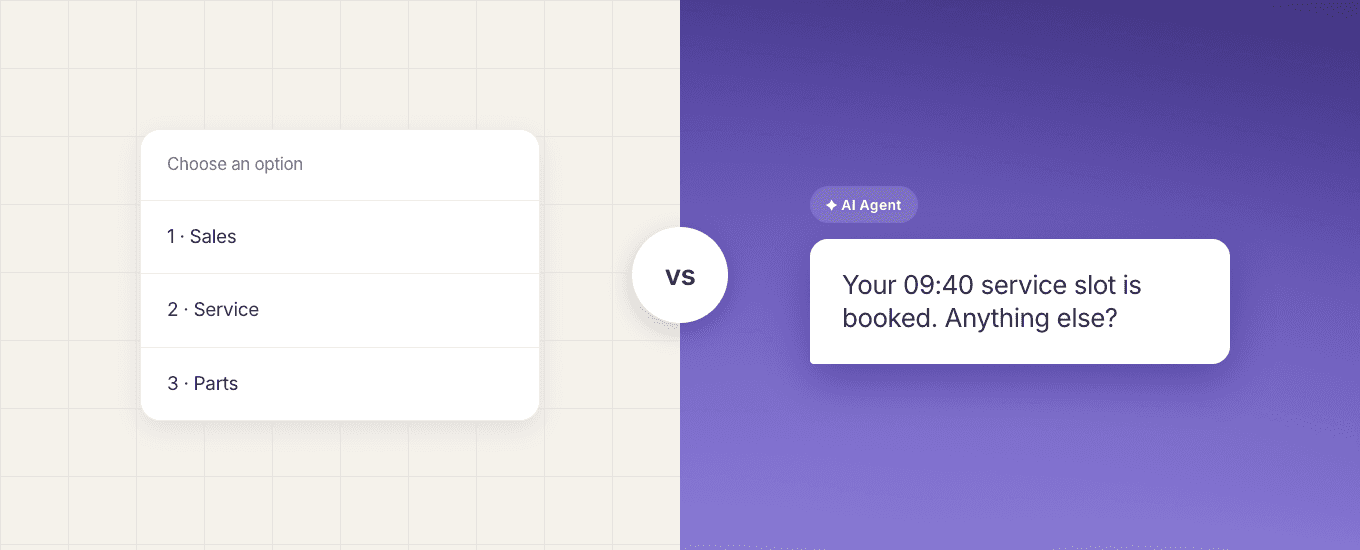

“AI agent” and “chatbot” get used almost interchangeably in automotive customer service marketing, but they describe different things, and the difference matters if you’re evaluating what a platform can actually do for your dealership.
The practical difference, in one example
A customer messages a dealership: “Can I get my car in for a service this week?”
A chatbot answers this by matching the message to a configured response, something like “You can book a service through our booking page, here’s the link,” and stops there. It’s reactive: it answers what it was built to answer, and hands off to a person for anything else.
An AI agent, in the fuller sense of the term, reads the same message, checks availability in the connected DMS, and replies with an actual slot: “We have availability Thursday at 10am or Friday at 2pm, would either work?” and books it once the customer confirms, without a person doing each of those steps manually. The distinction isn’t how natural the reply sounds. It’s whether the system checked a real system and took a real action, not just generated a plausible-sounding reply.
Why this matters for a dealership specifically
A chatbot that answers “what are your opening hours” is useful but limited. An agent that reads an incoming service enquiry, checks availability in the DMS, and books a slot is doing something structurally different, even if both get described as “AI” in a sales conversation. When you’re evaluating a platform, the useful question isn’t “does it have AI.” It’s “what specific actions does the AI take, in which systems, and what happens when it gets one wrong.”
What’s realistic today, across the market
Automotive customer service platforms sit at different points on this spectrum. Some describe agentic capability that reads context across a dealership and takes action in the DMS, payments, or campaign systems. Others, including where Cue is today, focus AI capability on customer service automation within supported messaging channels rather than autonomous multi-system actions. Neither position is inherently better. The right fit depends on how much autonomy you want a system to have before a person reviews what it’s done, and how much oversight your team has capacity to provide.
Human handoff and governance matter more than the label
Whatever a platform calls its AI, the practical questions are the same: what happens when the AI gets something wrong, how does a person take over cleanly, and what’s logged so you can review what happened afterwards. A well-governed chatbot with clear handoff rules can be a safer choice for some teams than a more autonomous agent with weak oversight, regardless of which one sounds more advanced in a demo. If a platform can’t show you what its handoff and audit trail actually look like, that’s worth treating as a bigger gap than whether it uses the word “agent” or “chatbot” to describe itself.
Where Cue sits today
Cue’s AI capability in automotive currently centres on customer service automation within WhatsApp and other supported channels, handling the volume of routine reminders, updates and responses that would otherwise take up an advisor’s day. Cue does not currently offer autonomous, multi-system agentic actions of the kind described in the example above. If and when that changes, it will be reflected directly on Cue’s product pages rather than described here ahead of availability.
For more on how this plays out specifically in aftersales, see WhatsApp for automotive aftersales, and for a broader look at AI in dealership customer service, see best AI customer service for car dealerships.
Frequently asked questions
Is an AI agent always better than a chatbot?
How can I tell if a platform's "AI agent" claim is real or just marketing language?
Does Cue plan to offer autonomous agentic AI in the future?
What happens when an AI agent gets something wrong?
Is agentic AI safe to use in a regulated context like automotive finance or warranty approval?
About the author

Grace Cowan
Head of Marketing
Grace is Head of Marketing at Cue, an omnichannel customer service platform. She works across B2B SaaS growth, customer experience and AI-led service, sharing practical insights on WhatsApp Business, customer communication and the strategies businesses can use to improve service and drive revenue.
Further reading

WhatsApp or SMS: how to choose for business messaging
Cost, message length, consent and delivery states compared, without the unsourced open-rate statistics, plus which channel fits which job.
Read the guide
Intercom alternatives: an honest comparison for customer service teams
What Intercom costs in 2026, how Fin's per-outcome pricing works, and which alternative suits which kind of team.
Read the guide

Fuzey vs Cue: which is the better fit for your dealership?
A fair, fact-checked comparison of Fuzey and Cue for automotive: channels, DMS integration, AI capability, proof and pricing.
Read the guide
