
Last updated
Grace Cowan
Customer service


A franchised dealership doesn’t have the same evaluation criteria as an independent garage picking its first messaging tool. There’s an OEM relationship to consider, a DMS that’s often mandated or at least strongly preferred, and performance metrics like CSI that get reported at manufacturer level, not just measured internally. The right platform has to work within that structure, not around it.
The five criteria that actually matter, and how to test each one
Channel breadth.
WhatsApp is usually the highest-impact channel for aftersales and reminders, but a platform that only does WhatsApp leaves live chat, Messenger and email as separate, disconnected tools. Test this by asking: if a customer replies on a different channel to the one you contacted them on, does the conversation stay in one place, or does someone have to go looking for it?
DMS integration, specifically named.
Any platform can claim to “integrate with your systems.” What matters is whether it names the DMS platforms it actually connects to, and what that connection actually does. Ask to see a live reminder triggered from a real booking in your own DMS, not a slide describing the concept.
AI capability that’s actually live.
This is worth checking carefully, because AI marketing in this space moves faster than AI shipping. A platform’s own site describing “AI agents” is not the same as a demonstrable, currently working feature. Ask specifically what’s live today versus what’s planned, and ask to see it running, not read about it.
Proof from comparable dealerships.
Generic SaaS case studies — a retailer, a bank, a telecoms company — don’t tell you much about automotive-specific results. Named, numbered results from other UK dealer groups are the closest thing to a genuine benchmark.
Franchise and OEM fit.
Check whether the platform’s proof and design account for OEM or network-level reporting, not just single-site use. If CSI and rebate performance matter to your role, this is the criterion that connects most directly to it.
What a weak answer to each of these sounds like
If you ask about DMS integration and get “we can connect to most systems,” that’s not a named answer. If you ask about AI and get a description of what the platform “can do” rather than a demonstration of what it does today, that’s a roadmap pitch dressed as a capability. If the proof offered is a general SaaS testimonial rather than a named UK dealer group with a specific number, it isn’t automotive-specific proof, however confidently it’s presented.
How platforms tend to differ on these criteria
Criterion | What to look for | Common weak spot |
|---|---|---|
Channel breadth | WhatsApp plus at least one other channel in one inbox | WhatsApp-only, marketed as “omnichannel” |
DMS integration | Named platforms, demonstrable trigger from live data | Vague “integrates with most systems” claims |
AI capability | A specific, demonstrable feature you can see running | Marketing language ahead of a shipped feature |
Proof | Named UK dealer group, specific number | Generic cross-industry testimonial |
OEM/network fit | Group-level reporting, multi-site rollout support | Built for single-site use only |
Where this leaves the evaluation
These five criteria won’t rank vendors for you, and no single article honestly can, since the right answer depends on which DMS you run and how many sites you’re standardising across. What they do is give you a consistent way to interrogate whatever platforms end up on your shortlist, rather than comparing marketing pages against each other.
If Fuzey is one of the platforms on your list, see Fuzey vs Cue for a direct, fact-checked comparison against these exact criteria. For a broader look at WhatsApp-specific providers for dealerships, see best WhatsApp providers for dealerships.
How Cue holds up against these criteria
Cue covers WhatsApp, live chat, Messenger and email in one platform, integrates with Keyloop, Pinewood, MGS and Dragon 2000, and publishes named results from Stellantis brands (196% increase in response rate, 14-point NPS increase) and Worthing Motors (55% increase in engagement, 30% increase in service bookings). Cue’s AI capability today centres on customer service automation within these channels; voice and deeper agentic capability are on the roadmap but not live, and this article doesn’t describe them as available.
It’s a better test of any platform, including Cue.
Frequently asked questions
Should I prioritise a platform built specifically for automotive, or a general customer service platform with an automotive angle?
Is it worth switching platforms if we’re already using something that mostly works?
What’s a reasonable timeframe to see measurable results after switching platforms?
How much does implementation typically disrupt day-to-day service operations?
Should a franchised dealer prioritise OEM approval or direct evaluation criteria?
About the author

Grace Cowan
Head of Marketing
Grace is Head of Marketing at Cue, an omnichannel customer service platform. She works across B2B SaaS growth, customer experience and AI-led service, sharing practical insights on WhatsApp Business, customer communication and the strategies businesses can use to improve service and drive revenue.
Further reading

WhatsApp or SMS: how to choose for business messaging
Cost, message length, consent and delivery states compared, without the unsourced open-rate statistics, plus which channel fits which job.
Read the guide
Intercom alternatives: an honest comparison for customer service teams
What Intercom costs in 2026, how Fin's per-outcome pricing works, and which alternative suits which kind of team.
Read the guide
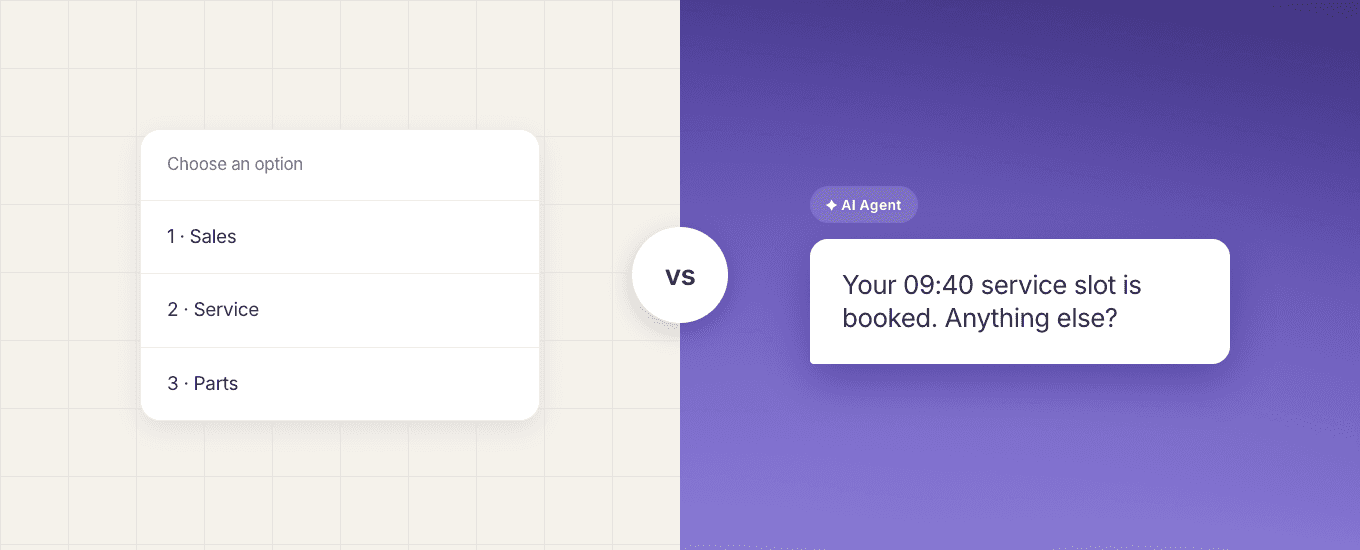
AI agents vs chatbots in automotive customer service
The real difference between a chatbot and an AI agent, and what it means for automotive customer service today.
Read the guide
