
Last updated
Grace Cowan


A customer engagement platform brings the conversations a business has with its customers into one place, across the channels those customers actually use. The category is crowded and inconsistently defined, which matters when you are choosing one: some products in it are campaign tools that send messages, and some are conversation platforms that can also handle what comes back. If WhatsApp is your main channel, that distinction decides whether the platform works for you.
What a customer engagement platform does
At minimum, a customer engagement platform gives you three things: somewhere to reach customers, somewhere to receive their replies, and a record of both against a contact.
Where products in this category diverge is which of those three they take seriously.
Marketing automation platforms are built around outbound. Segmentation, campaigns, journeys, lifecycle triggers. Strong at sending. Often weak or absent when a customer replies.
Customer service software is built around inbound. Queues, assignment, tickets, resolution. Strong at handling replies. Usually limited at proactive outreach beyond notifications.
Conversation platforms sit between the two: outbound messaging with a genuine inbox behind it.
None of these is the right answer in general. The right answer depends on whether your customer engagement is mostly you talking, mostly them talking, or genuinely two-way.
Why WhatsApp changes the requirements
Email set an expectation that a business sends and a customer maybe clicks. WhatsApp does not work that way. Send a message to a WhatsApp number and a meaningful share of recipients reply, with a question, a complaint, or a request that needs answering by a person.
That single behavioural difference invalidates a lot of platform shortlists.
Campaign tools versus conversation platforms
A campaign tool treats a WhatsApp broadcast as a send with delivery metrics attached. That is fine until the replies arrive, at which point they land somewhere nobody is watching, or in an inbox with no assignment, or route to a mailbox checked twice a day.
The test is simple and worth running in every demo. Send a message, reply to it as a customer, and watch what happens to your reply. Ask who it gets assigned to, what they can see, and how you would know if nobody answered.
What happens when a customer replies
Volume is the part people underestimate. A campaign that gets a strong response rate on WhatsApp generates inbound work in proportion. If that work has nowhere structured to go, the campaign’s success becomes an operational problem, and the usual response is to send fewer campaigns, which is the opposite of what you bought the platform for.
The four things to evaluate
Buyers researching this category consistently ask about the same four things. In rough order of how often they come up:
Scalability
Ask what specifically scales, because the word covers several different constraints:
People. Does adding an agent cost more? Per-seat pricing is common in this category and can make growing a team surprisingly expensive.
Contacts. Most platforms price on some version of active contacts or monthly volume. Understand the tier you are on and what happens at the boundary.
Sending. WhatsApp itself applies messaging limits and quality ratings that step up over time. This is Meta’s constraint, not your vendor’s, and no platform can override it.
Operations. Routing, assignment and reporting are what let 20 people work a queue that 5 people used to. This is usually the real constraint, and the least demoed.
Cue prices on monthly active contacts with unlimited seats on every plan, which moves the variable from headcount to volume. Scaling the team is a matter of adding people to the shared inbox, not adding licence cost.
Security and data handling
The questions worth asking any vendor in this category:
Where is customer data stored and processed, and can you specify a region?
What compliance regimes does the platform hold. GDPR, POPIA, others relevant to your market?
How is access controlled? Is there single sign-on, and role-based access so agents see only what they should?
Can sensitive fields be hidden from the general agent view?
If the platform uses AI, where does the conversation content go? This one is frequently skipped. Ask directly whether conversation history is sent to a third-party model provider, and get the answer in writing.
Cue is GDPR and POPIA compliant, supports SAML single sign-on with Google and Microsoft Entra ID, and offers role-based access and sensitive contact fields that stay hidden from the inbox. Where Cue AI Agents are used, conversation history, which may include personal data, is processed by OpenAI, so deployments handling sensitive information should go through a privacy review.
Integrations
“Integrates with” covers an enormous range. Get specific:
Which direction does data move? Reading from your CRM and writing to it are different pieces of work.
Is it real-time, scheduled, or triggered by an event?
Is it a configured connector, or an API call somebody has to build and maintain?
What happens when it fails? Retries, alerts, or silence?
A logo on an integrations page proves a route exists, not that your specific workflow is supported. Ask to see your use case, with your systems, before signing. Cue handles integrations through configured connectors, HTTP requests inside Flows, webhooks and APIs, and our WhatsApp CRM integration guide sets out what that involves in practice, and how much work each involves varies genuinely by system, which is worth establishing early rather than discovering in implementation.
Pricing
The models in this category are not comparable without doing arithmetic:
Model | Priced on | Watch for |
|---|---|---|
Per seat | Number of agents | Cost rises with team growth; AI often a separate per-seat add-on |
Per contact | Active contacts per month | What counts as active, and the cost at tier boundaries |
Per conversation | Volume handled | Definition of a conversation, and how it differs from the platform’s own count |
Per outcome | AI resolutions | What counts as resolved, and who decides |
Flat platform fee | Included allowances | What is included, and the overage rate |
Two extra costs to surface before you compare anything: Meta’s own conversation charges, which are separate from your platform fee on every WhatsApp vendor, and onboarding or implementation fees, which are not always on the pricing page.
Cue starts at £249 a month with unlimited seats and publishes its full plan comparison, including AI resolution rates, £1.49 pay-as-you-go, falling to £0.99 and £0.89 with bundles. Onboarding is included from the Automate plan up; the entry Connect plan carries a one-off fee equal to one month’s subscription.
Run this checklist against Cue
WhatsApp broadcasts, two-way conversations, chatbots and AI answers in one platform. Unlimited seats, GDPR and POPIA compliance, pricing published from £249 a month.
Book a demo · Or compare plans and pricing
Engagement platform, marketing automation or customer service software?
Marketing automation | Customer engagement platform | Customer service software | |
|---|---|---|---|
Built for | Outbound campaigns | Two-way conversation | Inbound resolution |
Strongest at | Segmentation, journeys | Messaging plus handling replies | Queues, assignment, resolution |
WhatsApp replies | Often unhandled | Handled in a shared inbox | Handled, if WhatsApp is supported |
Proactive outreach | Extensive | Channel-dependent | Usually limited |
Bought by | Marketing | Marketing and service together | Customer service |
If your honest answer is that you mostly send and rarely need to respond, marketing automation is the cheaper and better fit. Most businesses on WhatsApp find the opposite.
What good looks like in practice
Two examples of engagement running as conversation rather than broadcast.
Richfield, an education provider, moved prospective-student outreach from calling to WhatsApp broadcasts with live chat behind them, and reported a sevenfold increase in response rates alongside a 65% rise in call-to-action conversion. The response volume is the point, it only worked because replies had somewhere to go.
University College Birmingham switched event communications from SMS to WhatsApp through Cue and reported engagement rising from around 31% to 78%, with winter event conversion moving from 41% to 62% year on year, a 21 percentage-point increase.
Both are single-organisation outcomes reported by those organisations, not industry benchmarks. They indicate what is achievable in a comparable setup, not what any business should expect.
A checklist for shortlisting
Take this into demos:
Does adding an agent change the price?
What exactly counts as an active contact, and what happens at the tier boundary?
Send a message, reply as a customer, where does the reply go and who owns it?
Which of my systems integrate, in which direction, and is it configured or built?
Where is data stored, and does conversation content reach a third-party AI provider?
What are Meta’s charges on top of the subscription?
Is there an onboarding fee?
Can I see routing, assignment and reporting with realistic volume, not a demo account?
Most engagement platforms are built to send. The test that matters is what happens when a customer replies. Book a demo and bring the four questions in this article with you, or read how Cue works for marketing teams.
Frequently asked questions
What is a customer engagement platform?
What is the difference between a customer engagement platform and marketing automation?
How do I evaluate a customer engagement platform for scalability?
Can a customer engagement platform handle two-way conversations on WhatsApp?
Does a customer engagement platform need to integrate with a CRM?

Further reading
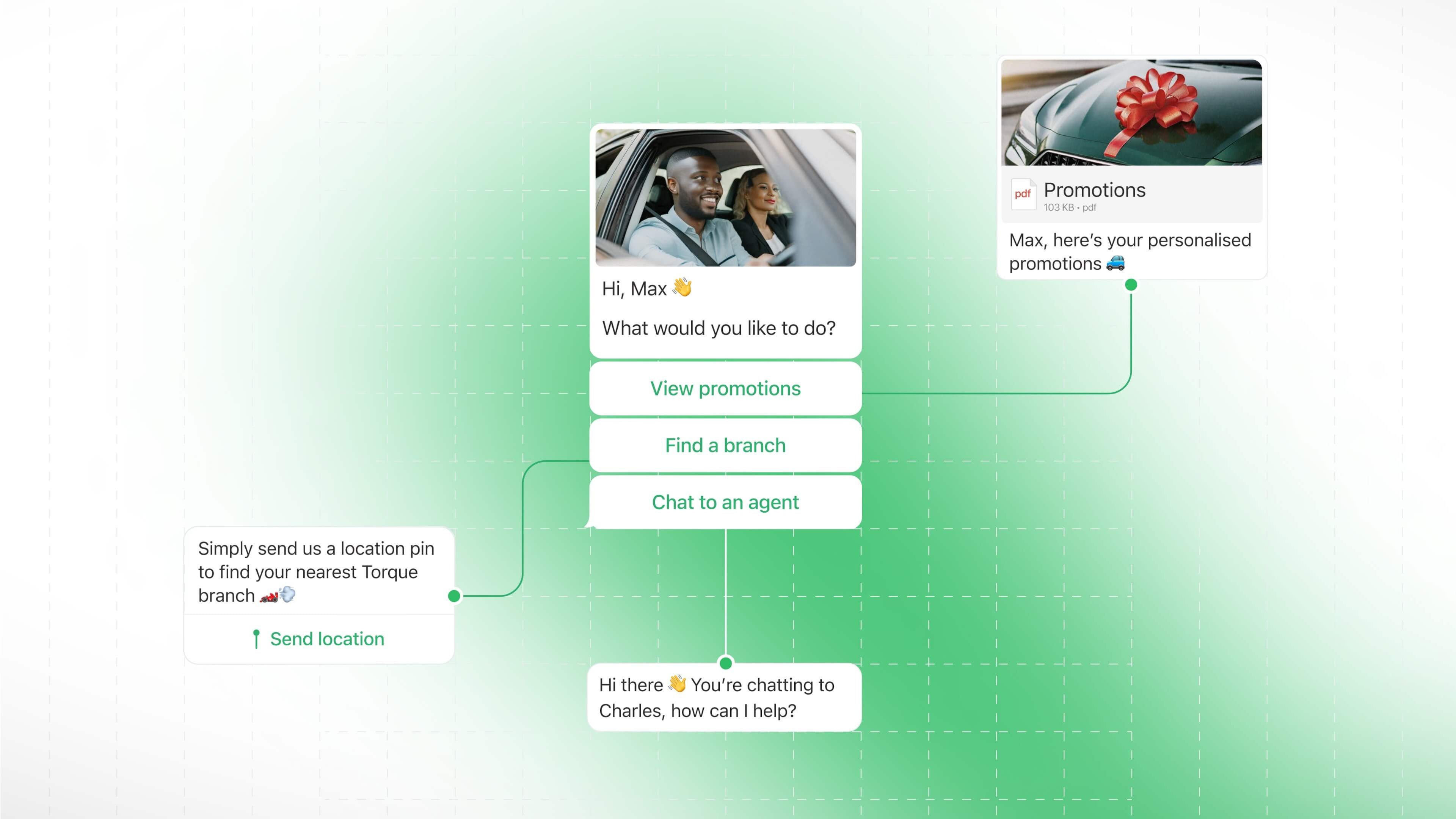
WhatsApp buttons and menus: every interactive message type, explained
Reply buttons, CTA buttons, list menus and template buttons: what each does, the limits Meta publishes, and how to build a working menu.
Read the guide
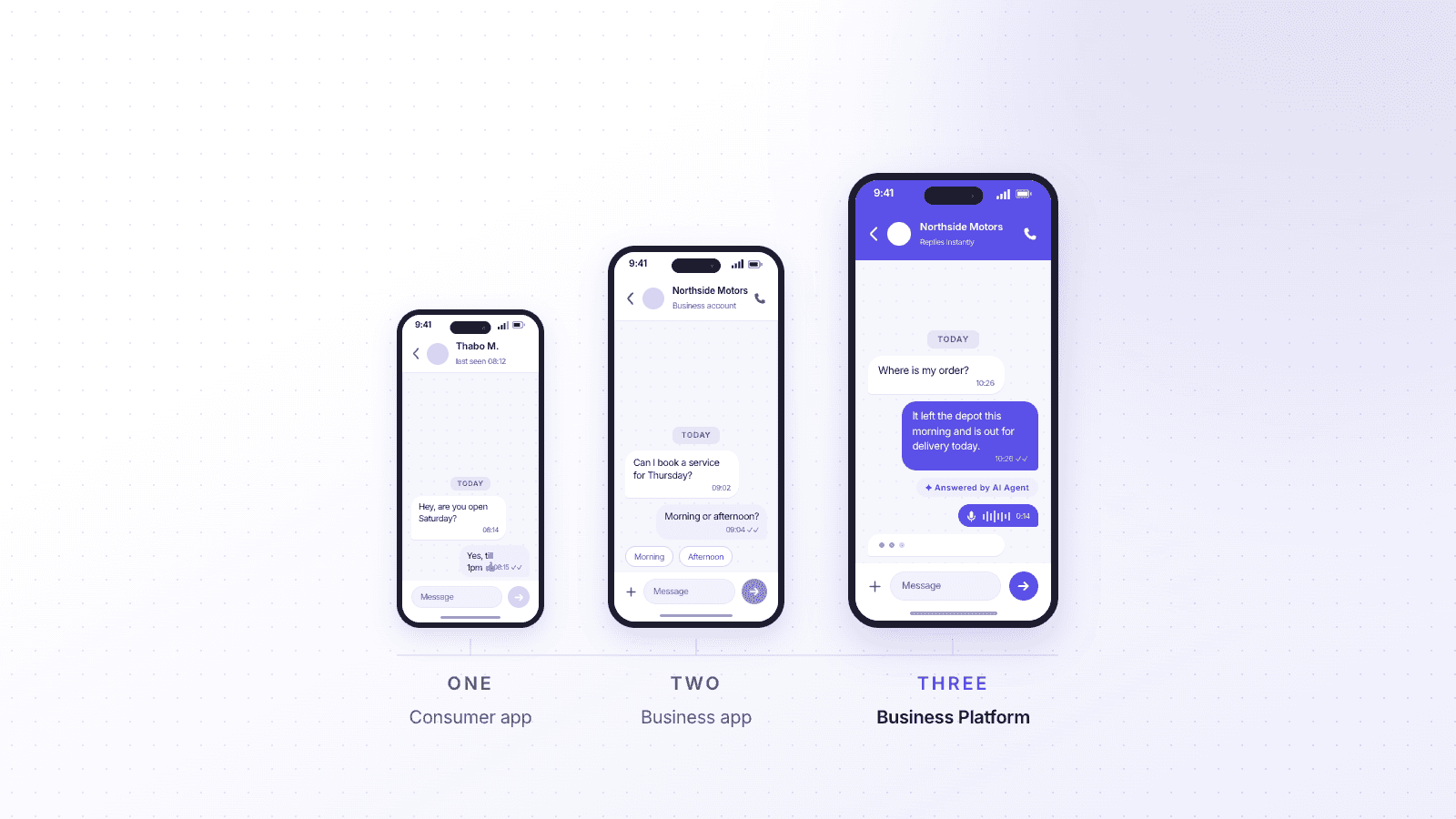
What is a WhatsApp Business account?
The three versions of WhatsApp explained, what the free Business app can and cannot do, and the signals that you have outgrown it.
Read the guide

Is WhatsApp Business free?
The free app really is free. Here is where the costs start, what Meta charges per message, and why the platform fee is the real decision.
Read the guide
