
Last updated
Kirsten Gentle


A fast auto-reply isn't the same thing as automation that actually holds a conversation together.
Automating the first response means an AI Agent answers or qualifies immediately, not a canned "thanks for reaching out" that still leaves a human to do the real work later.
The failure point is usually the handoff: a bot replies fast, then a human joins with no context and the customer repeats themselves.
Conversation ownership matters as much as speed. Two agents replying to the same thread is its own kind of dropped ball.
CRM sync is what actually stops things falling through the cracks, an inquiry should become a tracked record automatically, not a task someone remembers to log.
If you want platform comparisons or a deeper shared-inbox feature list, we've covered both elsewhere, linked below, so this piece stays focused on the automation itself.
A customer messages your WhatsApp number at 7 PM asking about a delayed order. They get an instant reply: "Thanks for your message! We'll get back to you soon." Then nothing, until an agent picks it up the next morning, asks the same question the bot could have already answered, and the customer has to explain the whole thing again.
That's automation in name only. Real first-response automation means the first reply actually does something, answers the question, asks the right follow-up, or routes the inquiry to the right place, and it means whatever happens next doesn't lose the thread. Here's how that actually works.
What does automating a WhatsApp first response actually mean?
There's a real difference between an auto-reply and automation. An auto-reply acknowledges a message. Automation resolves it, or moves it forward. A good AI Agent reads the incoming message, checks whether it's a question with a known answer (order status, opening hours, pricing), and either answers it directly or asks a clarifying question, all within the first reply, not after a human eventually gets to it.
That distinction is worth the setup effort. 92% of customer service leaders now say AI has improved their team's response quality, and 75% say it has specifically reduced response times, per HubSpot's State of Customer Service research. The gap between those numbers and a plain auto-reply is the entire point of doing this properly.
How does AI handle the moment between the message and a human reply?
A well-built AI Agent doesn't wait for a human to be free. It reads the message, pulls relevant account or order information if it's connected to one, and responds immediately with something useful, not a placeholder. If the question is simple, it resolves it there. If it isn't, it asks the questions a human would ask first, so whoever picks up the conversation next isn't starting from zero.
This is also where 24/7 coverage actually earns its keep. A message at 7 PM or on a Sunday gets the same immediate, useful first response as one sent at 10 AM on a Tuesday, which is the whole gap a canned auto-reply was never built to close. eMarketer's global messaging app data puts WhatsApp's active user count above 2.7 billion as of 2024, making it the world's most-used messaging platform. Customers aren't going out of their way to reach you on it. They're already there.
Who owns the conversation once a human joins?
This is where a lot of setups quietly break. A bot resolves the first exchange, then a human needs to step in, and if ownership isn't clear, one of two things happens: two agents both reply, confusing the customer, or nobody's sure whose job it is and the thread goes quiet. A shared inbox with clear assignment rules, one owner per conversation, visible to the whole team, is what prevents both.
We've written a deeper guide to what a shared WhatsApp inbox needs for real team collaboration, tagging, internal notes, status tracking, so this piece won't re-cover that ground. The short version for first-response purposes: automation should hand off to a named owner, not a general queue.
How does escalation actually work?
Escalation is the moment the AI Agent decides a human needs to take over, and how well that moment is handled matters more than how often it happens. The bot should pass the full conversation history and whatever it's already learned (order number, issue type, sentiment) along with the handoff, so the agent picks up mid-conversation instead of asking the customer to start over.
The industry consensus on this is clear: deploy AI for initial triage and routine issues, but keep the path to a human rep immediate for anything complex or sensitive, and be transparent with the customer about which one they're talking to. Get that balance wrong in either direction, escalating too eagerly or too rarely, and the automation stops earning its keep.
How does this connect to the CRM so nothing falls through the cracks?
This is the part most WhatsApp automation setups skip, and it's usually the actual point of buying one. An enquiry that gets answered but never becomes a CRM record is still a dropped ball, just a slower one. When a conversation resolves or escalates, the contact, the issue, and the outcome should sync to the CRM automatically, so a follow-up doesn't depend on someone remembering to type it in later.
It matters more than most teams budget for: 64% of service leaders planned to increase investment in transforming their CRM into a single source of truth in 2024, per HubSpot's State of Customer Service research, and the teams who haven't done it are still the ones manually re-typing resolved conversations into a system that should already know about them.
What about comparing WhatsApp platforms for this?
We've already built a full comparison of WhatsApp Business Solution Providers, covering Cue, Wati, Trengo, Intercom, Bird, and others, so we won't repeat that here. This piece is about the automation itself: what a good first response should do, not which vendor to pick. If you're at the platform-selection stage, that comparison is the better starting point.
Cue's AI Agents handle first response, escalation with full context, and CRM sync from Cue's WhatsApp channel as one connected setup, rather than three separate tools stitched together. Cue's pricing starts at £249 a month with unlimited seats, so adding agents to handle escalations doesn't add a per-seat cost on top.
What should first-response automation actually do?
Answer or qualify immediately: not "we'll get back to you," an actual response to what was asked.
Work around the clock: a 7 PM message gets the same quality of first reply as one sent at noon.
Hand off with full context: whoever picks up next sees the whole conversation, not a blank thread.
Assign clear ownership: one named owner per conversation, so nothing sits in a shared queue unclaimed.
Sync to the CRM automatically: the enquiry becomes a tracked record the moment it resolves or escalates, not after someone remembers.
What result has a Cue customer seen from AI-handled first responses?
Payflex, a buy-now-pay-later provider in South Africa, was getting hit with a spike in support tickets as their customer base grew, with slow, manual processes for verification and account queries piling pressure on a small team. They needed something that could act as the first line of response around the clock, and hand off cleanly when a query needed a human.
Cue's AI Agents became that first line: available 24/7, trained on Payflex's own knowledge base and website, and built to route anything complex straight to a live agent rather than trying to force an answer. The result, per Payflex's Cue case study: an 82% resolution rate without a human ever joining the conversation. Financial services queries carry their own regulatory and trust considerations, so treat this as a strong, real result from a specific vertical rather than a universal number.
Pricing and features verified as of July 2026.
Key takeaways
An auto-reply and real automation aren't the same thing. One acknowledges a message, the other actually moves it forward.
The handoff from bot to human is where most setups quietly fail, context needs to travel with the conversation, not get left behind.
Conversation ownership prevents duplicate replies and abandoned threads just as much as speed prevents slow ones.
CRM sync is what actually stops enquiries falling through the cracks, and 64% of service leaders are now prioritising exactly this kind of single-source-of-truth investment.
Platform choice matters, but it's a separate decision from getting the automation itself right, covered in our WhatsApp provider comparison.
Frequently asked questions
What's the difference between an auto-reply and real first-response automation?
How does a bot know when to escalate to a human?
Can two agents accidentally reply to the same WhatsApp conversation?
Does first-response automation work outside business hours?
How does WhatsApp automation actually connect to a CRM?
Which WhatsApp platform should I actually pick for this?
Is AI handling the first response risky for sensitive queries?
About the author

Kirsten Gentle
Performance Manager
Kirsten Gentle is fascinated by how customer service actually works once real conversations start arriving. At Cue, she works closely with service teams across WhatsApp, email and live chat, looking at what changes when a business moves from juggling channels to running them properly. She writes about the practical side: routing, response times and the handovers in between.
Further reading
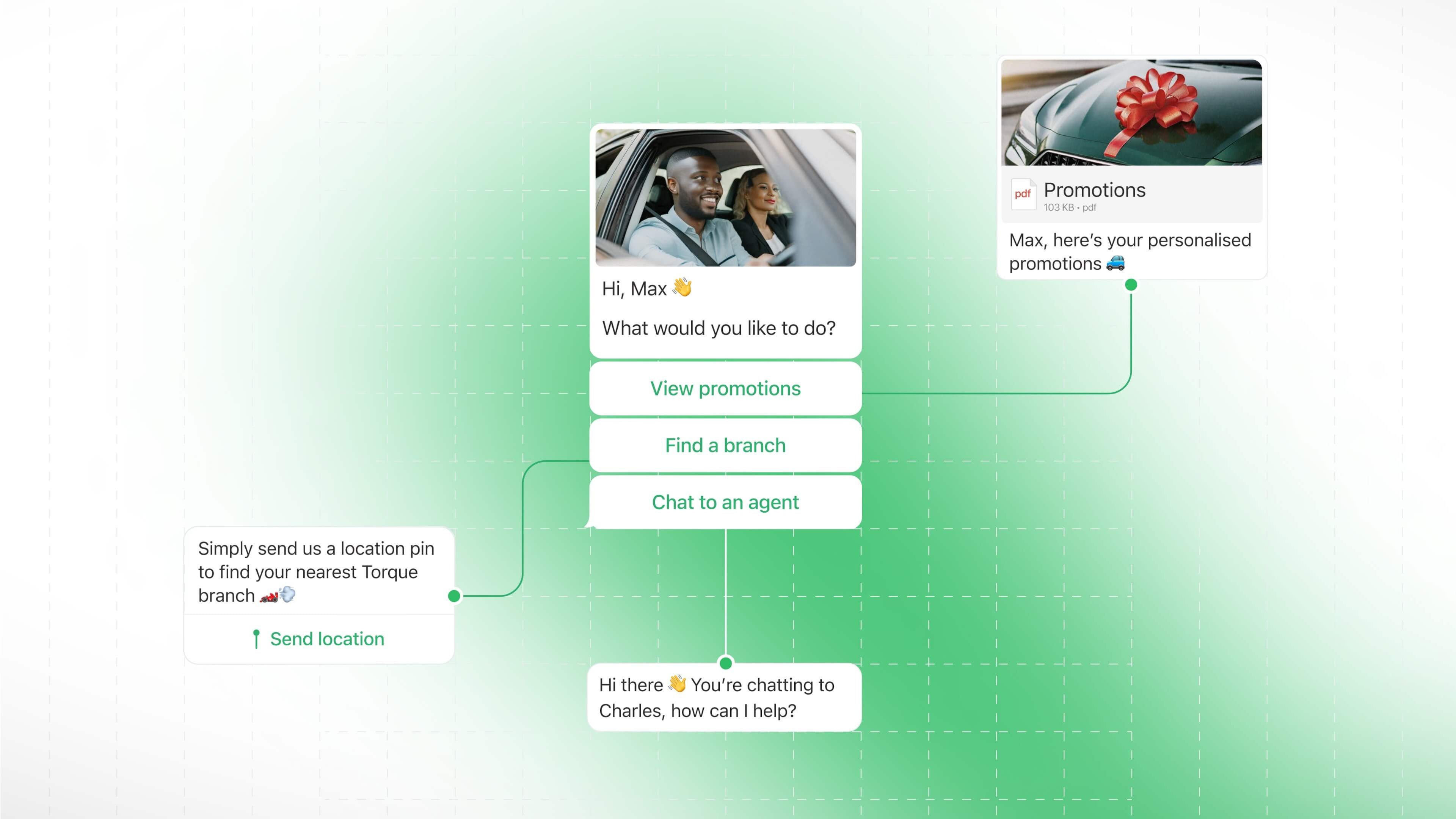
WhatsApp buttons and menus: every interactive message type, explained
Reply buttons, CTA buttons, list menus and template buttons: what each does, the limits Meta publishes, and how to build a working menu.
Read the guide
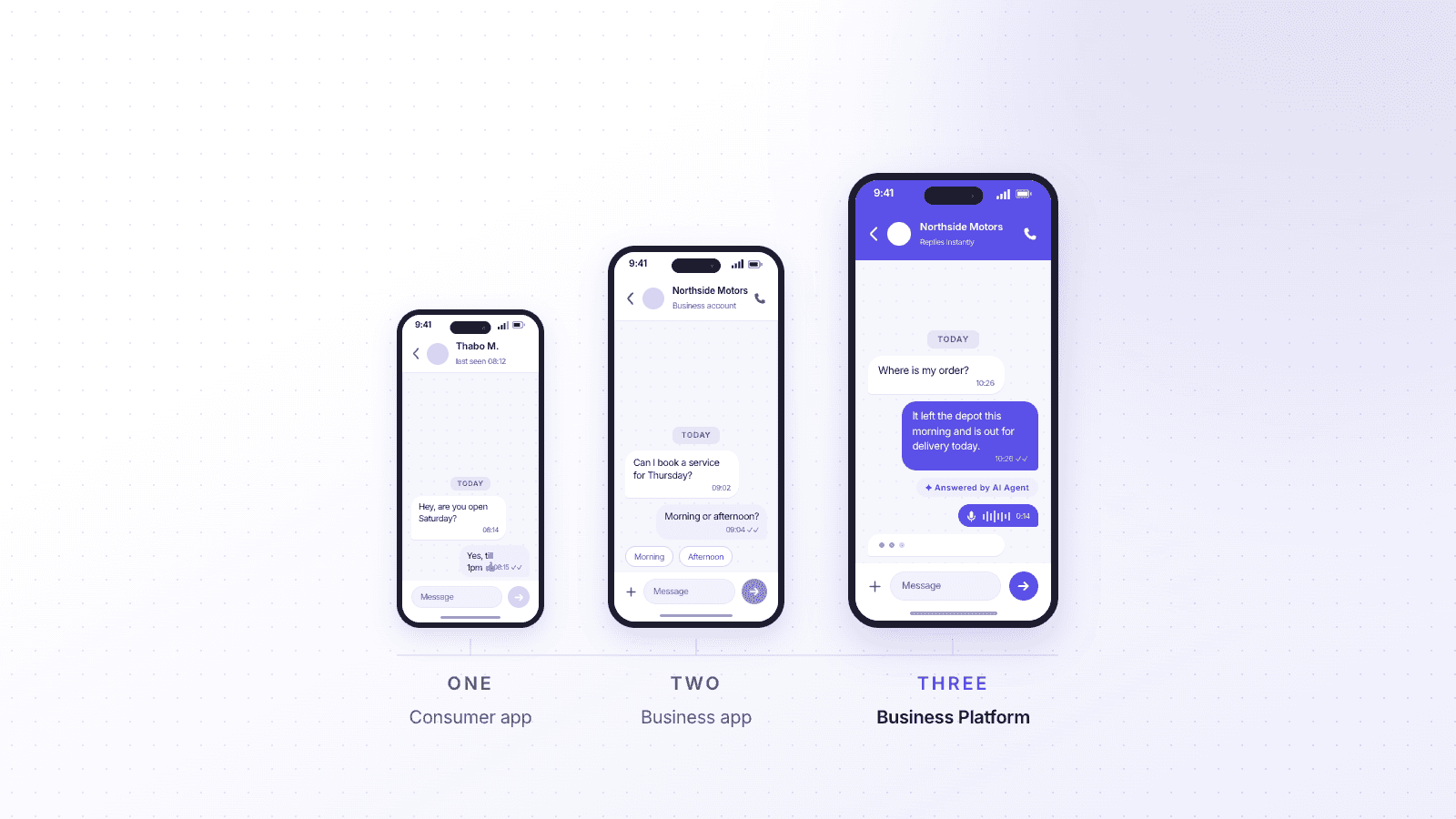
What is a WhatsApp Business account?
The three versions of WhatsApp explained, what the free Business app can and cannot do, and the signals that you have outgrown it.
Read the guide

Is WhatsApp Business free?
The free app really is free. Here is where the costs start, what Meta charges per message, and why the platform fee is the real decision.
Read the guide
