Yes, when the problem is urgent or complicated. In CCMA’s Spring 2026 survey of 2,000 UK adults, phone was the preferred channel for 68% of people with urgent queries and 55% with complex ones. For simple queries, email (48%) edged ahead of phone (41%).
A route to a person matters too. In the Institute of Customer Service’s UK Customer Satisfaction Index (UKCSI) for July 2026, 32.6% of customers ranked being able to speak to someone when they need to among their top priorities. Only 15.8% thought it was a priority for organisations.
So keeping the phone is the easy part. The harder part is making sure the route between phone, messaging and a person holds up when a customer needs it.
When UK customers still want to pick up the phone
UK customers prefer to phone when a query is urgent or complex. CCMA’s research, Beyond Demographics: Customer Contact Personas Shaping UK Service Expectations, surveyed 2,000 UK adults in spring 2026. Phone was the preferred channel for 68% of respondents with urgent queries and 55% with complex queries. For simple queries the picture flipped, with 48% preferring email and 41% preferring phone. (CCMA)
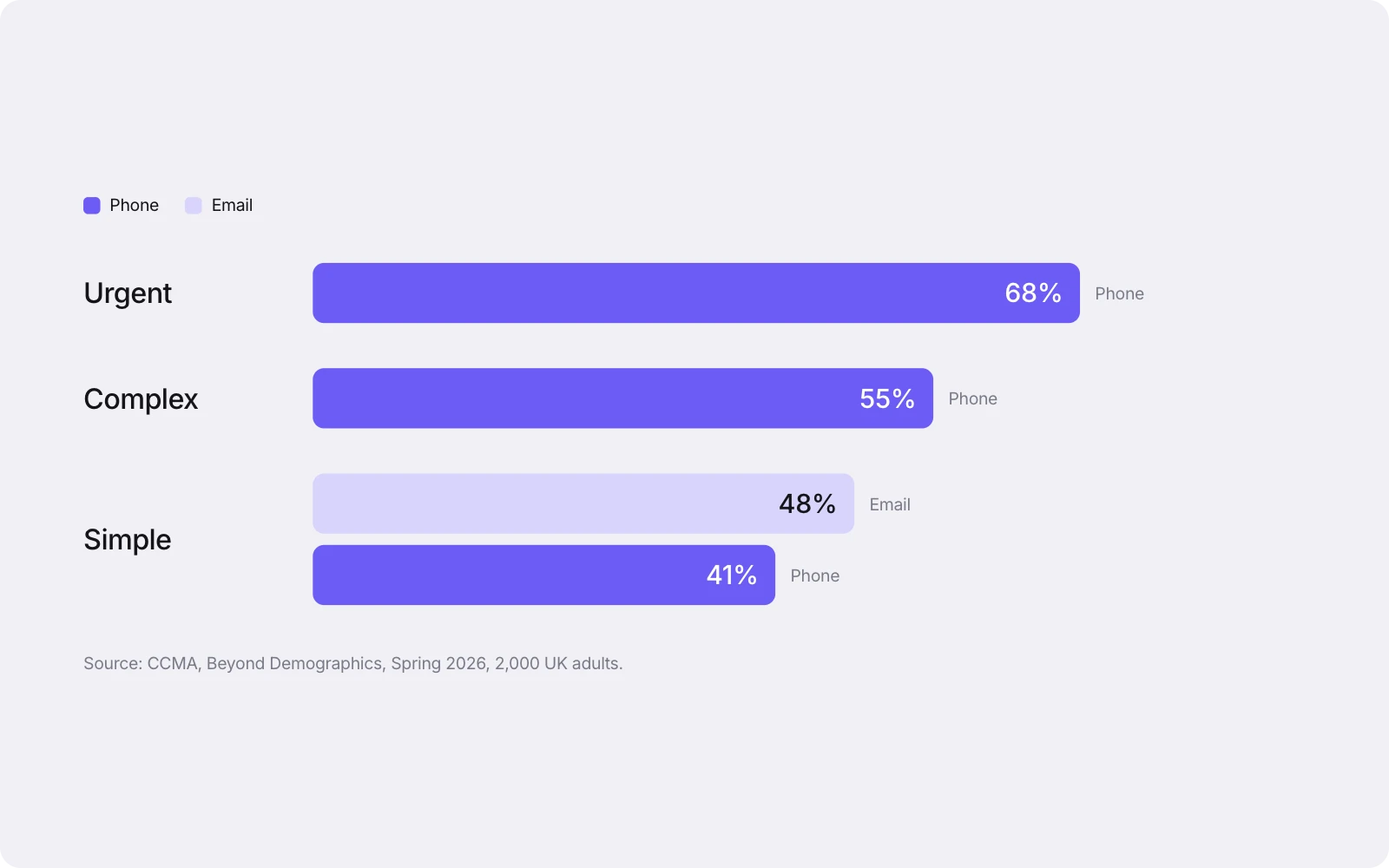
Two things are worth holding on to. These are preferences, not call volumes, so they won’t tell you how many calls to staff for. And the split depends on the job. The same person who’s happy to email about a delivery date may want to ring the moment something goes wrong.
There’s no comparable UK figure for emotional or high-value enquiries, but you’ll recognise the kind of contact that ends up on the phone anyway:
a car that’s failed its MOT two days before a long drive
a payment taken twice in the same week
a disputed bill the customer has already raised once
a bereavement, where someone needs to close an account
Urgent and complex enquiries have something in common. The customer needs fast back-and-forth and some reassurance that a named person owns the problem. A call gives them both at once. That doesn’t make phone the answer for everything, but it’s why removing it for these cases leaves a gap that messaging alone won’t fill.
Phone or WhatsApp: it depends on the job
Neither channel wins across the board. A better approach is to match the first channel to the type of enquiry, then agree in advance what moves a conversation from one channel to the other.
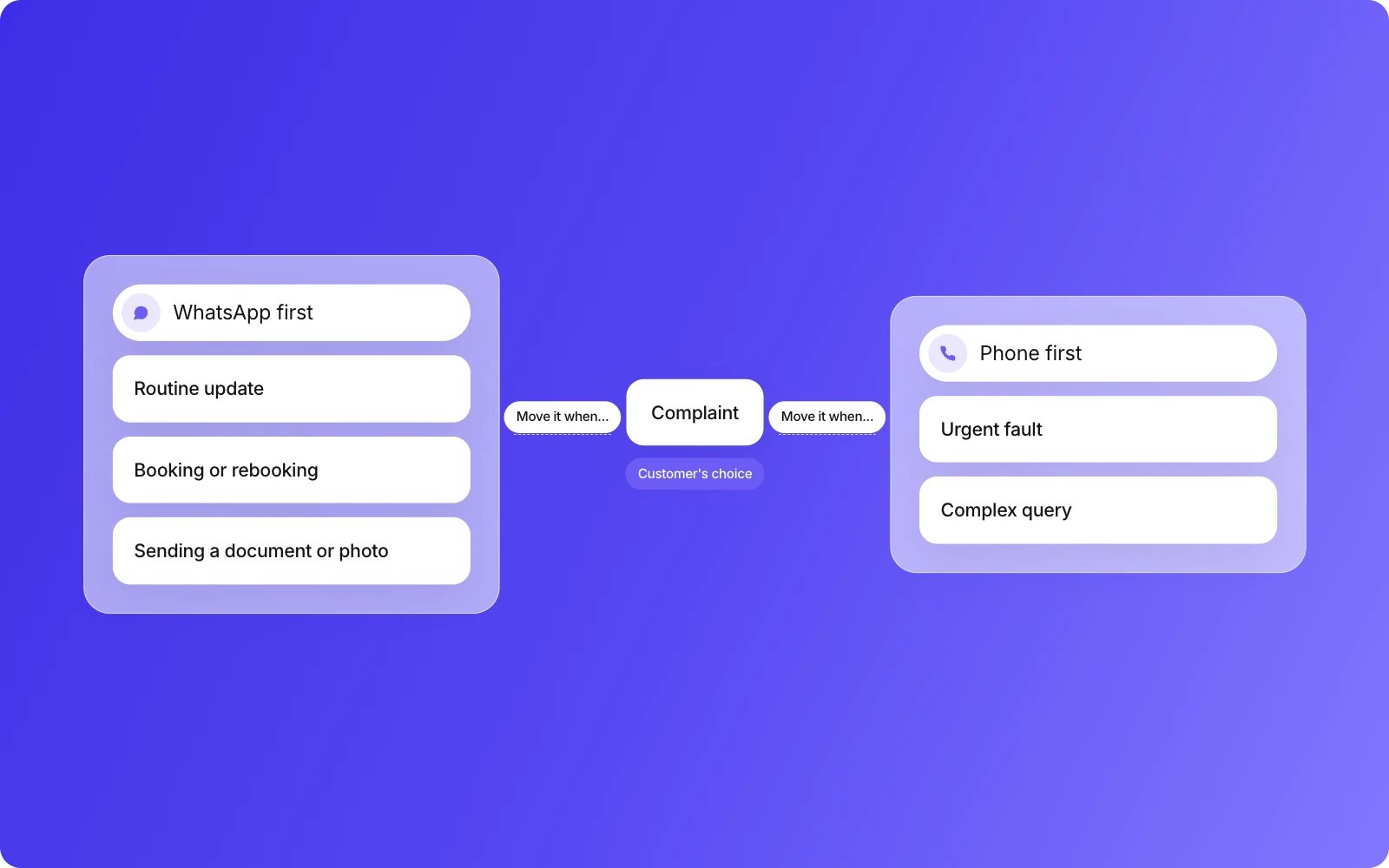
This table is a starting point to adapt to your own enquiries. It’s guidance, not research data.
Enquiry | Sensible first channel | Move it when |
|---|---|---|
Routine update (order, repair or appointment status) | WhatsApp or email | The customer replies with a question the update can’t answer |
Booking or rebooking | WhatsApp, with phone available | The customer needs to talk through options, or none of the slots work |
Sending a document or photo | The document raises something that needs explaining | |
Urgent fault | Phone | The fix needs photos or reference numbers, so add WhatsApp alongside the call |
Complex query | Phone, or chat with a named agent | The customer is repeating themselves or the answer needs a judgement call |
Complaint | The customer’s choice, with phone offered | The customer asks to speak to someone, or money or vulnerability is involved |
The “move it when” column is the one to write down first. Without it, agents decide case by case and customers get a different experience depending on who picks up.
If you run a dealership, our guide to WhatsApp vs phone calls for dealership communication applies the same split to aftersales.
Where messaging does the job better
Messaging suits work that doesn’t need both people there at the same moment: updates, confirmations, documents, photos and conversations the customer wants to pick up later.
Meta’s State of Business Messaging 2026 report, based on Kantar research commissioned by Meta, surveyed 11,056 online adults aged 18 to 64 across 22 markets between April and September 2025. It found 73.3% prefer messaging when communicating with a business, 69% say waiting on hold is a waste of time, and 66.8% feel frustrated when messaging isn’t offered. (Meta) These are global figures. The UK is included, but there’s no UK-only breakdown, and the survey covers business messaging in general rather than WhatsApp specifically.
In the UK, the reach is already there. Ofcom’s Online Nation 2025 report found 90% of UK online adults used WhatsApp in May 2025, and 74% used it daily. (Ofcom) That measures use of the app, not a preference for contacting businesses through it.
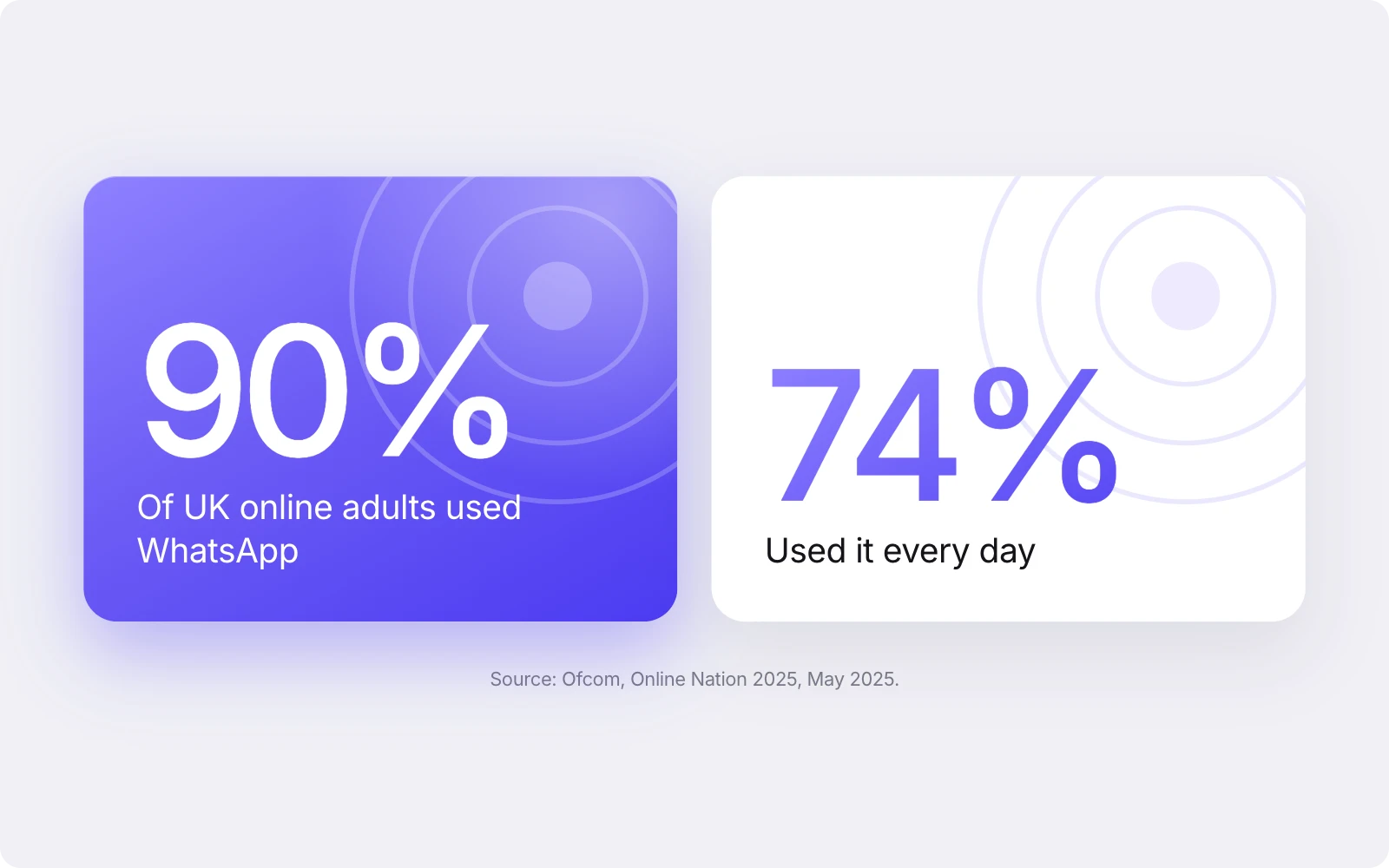
A general preference for messaging and a preference for calling when something’s urgent don’t contradict each other. They describe different moments.
Cue customers have seen what moving the right jobs onto WhatsApp can do. These are WhatsApp results, not phone results:
Worthing Motors saw survey engagement rise by 55% after moving post-service surveys and updates onto WhatsApp with Cue. NPS survey returns went from 111 in Q1 2025 to 173 in Q1 2026.
Stellantis brands saw a 196% increase in customer response rate and a 14-point improvement in NPS across their network.
If you’re weighing up messaging channels, our comparison of WhatsApp vs SMS covers where each fits, and you can see how Cue handles WhatsApp for customer service.
Customers need a route to a person
Customers want to know they can reach a person when they need one, and UK research suggests they think organisations are heading the other way. In UKCSI July 2026, 32.6% of customers ranked “ability to speak to someone when I need to” as a top-three priority, while only 15.8% thought it was a priority for organisations. Self-serve ran in the opposite direction: 15.3% of customers ranked it a priority, against 22.1% who thought organisations focus on it.
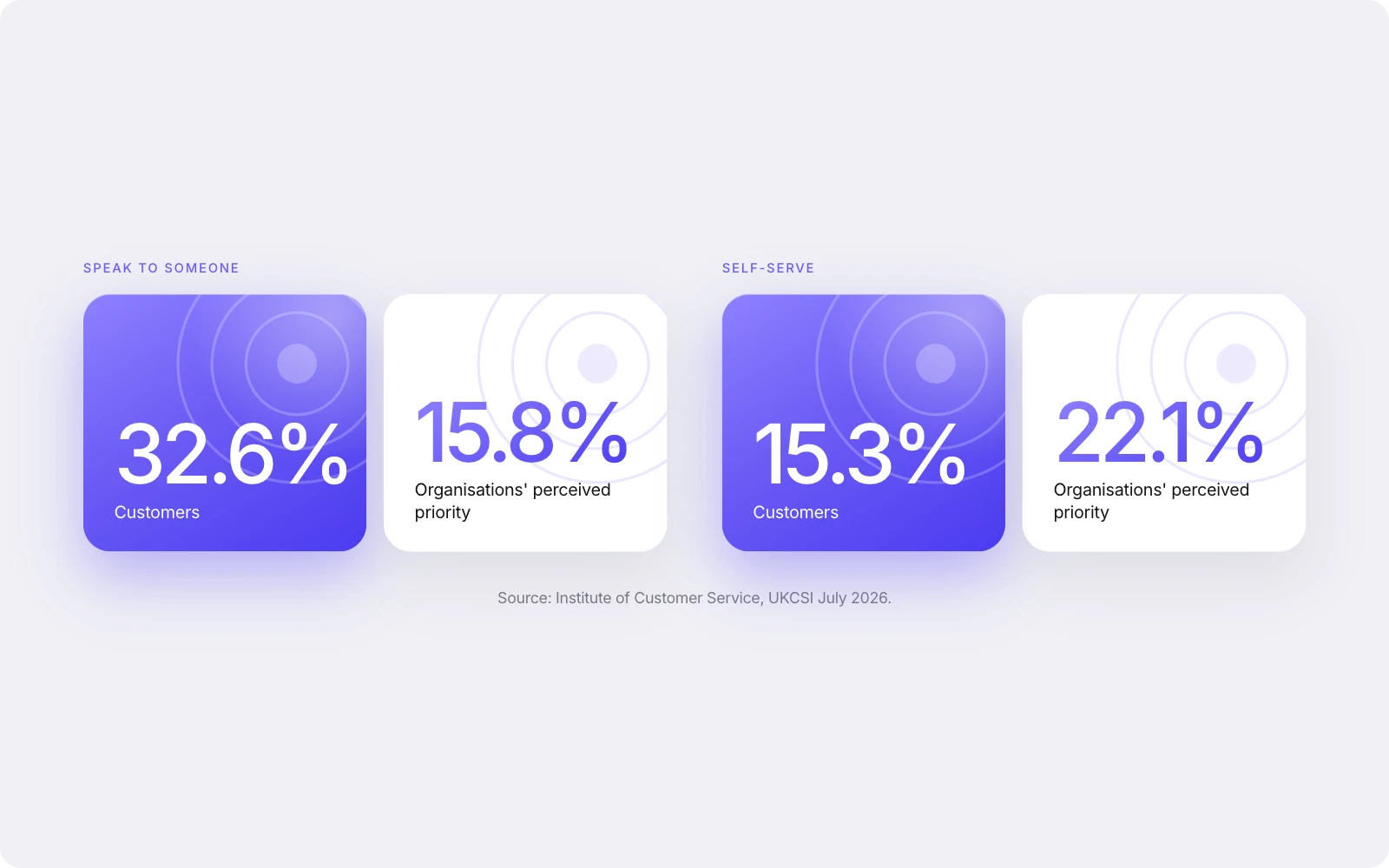
For some customers it matters more than it did. Being able to speak to someone has become more important for 16.0% of customers, rising to 21.6% of those in poor financial wellbeing (UKCSI July 2026).
“Speak to someone” doesn’t have to mean a phone call. A live agent on WhatsApp or web chat is a person too. What matters is that the customer can get past the automated layer when it isn’t working.
Self-service on its own rarely gets there. Gartner’s survey of 5,728 customers in December 2023 found only 14% of service issues were fully resolved in self-service, rising to 36% for issues customers considered very simple. (Gartner) The same survey found 64% of customers would prefer companies didn’t use AI for customer service, with difficulty reaching a person among the main concerns. (Gartner)
The real problem: two channels, two systems
Customers don’t think in channels. When phone sits in one system and WhatsApp in another, context gets lost at the point a customer moves between them, which is exactly when they least want to repeat themselves.
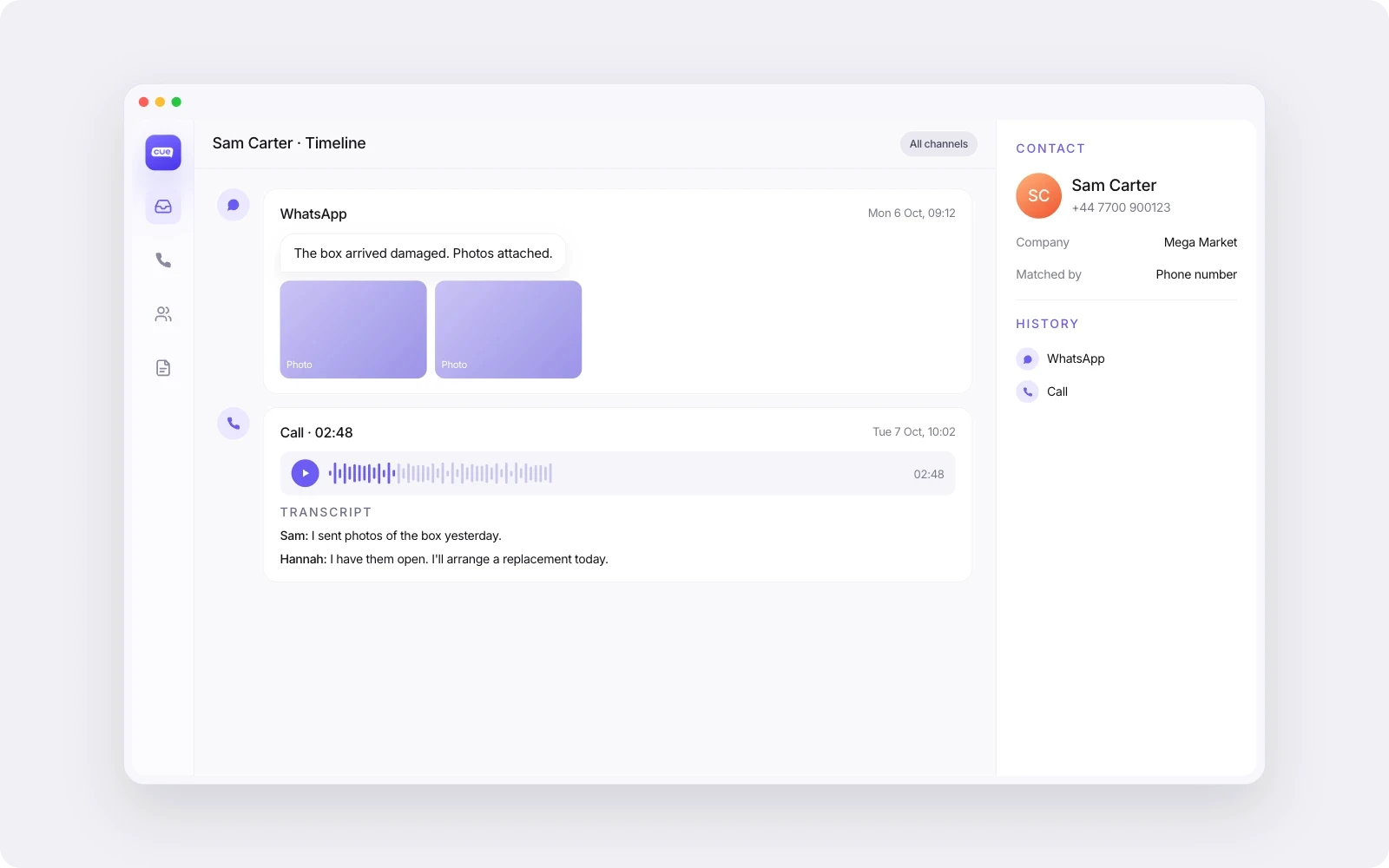
Picture it. A customer sends photos of a fault on WhatsApp, waits, then rings because it’s become urgent. The agent who answers can’t see the photos or the earlier messages, so the customer explains it all again. They’ve used two channels and got a worse experience than if they’d used one.
UKCSI July 2026 makes the same point in its recommendations: map and track hand-offs between channels, and make sure customers can speak to a person.
The fix is one customer record across calls and messages. That’s how Cue Phone works. Agents take and make calls from the same inbox they use for WhatsApp, email and chat, and callers are matched to their contact record by phone number. Calls can be recorded and transcribed, and the recordings and transcripts sit on the contact record alongside the WhatsApp, email and chat history, so the whole conversation is in one place.
You can get a new UK or South African number through Cue, or bring your existing number across. Numbers in other countries are available on request.
For more on why this matters, see omnichannel vs multichannel customer service, and for the practical side of answering and routing calls, our guide to inbound call handling.
Should you move callers onto WhatsApp?
Offer it. Don’t force it.
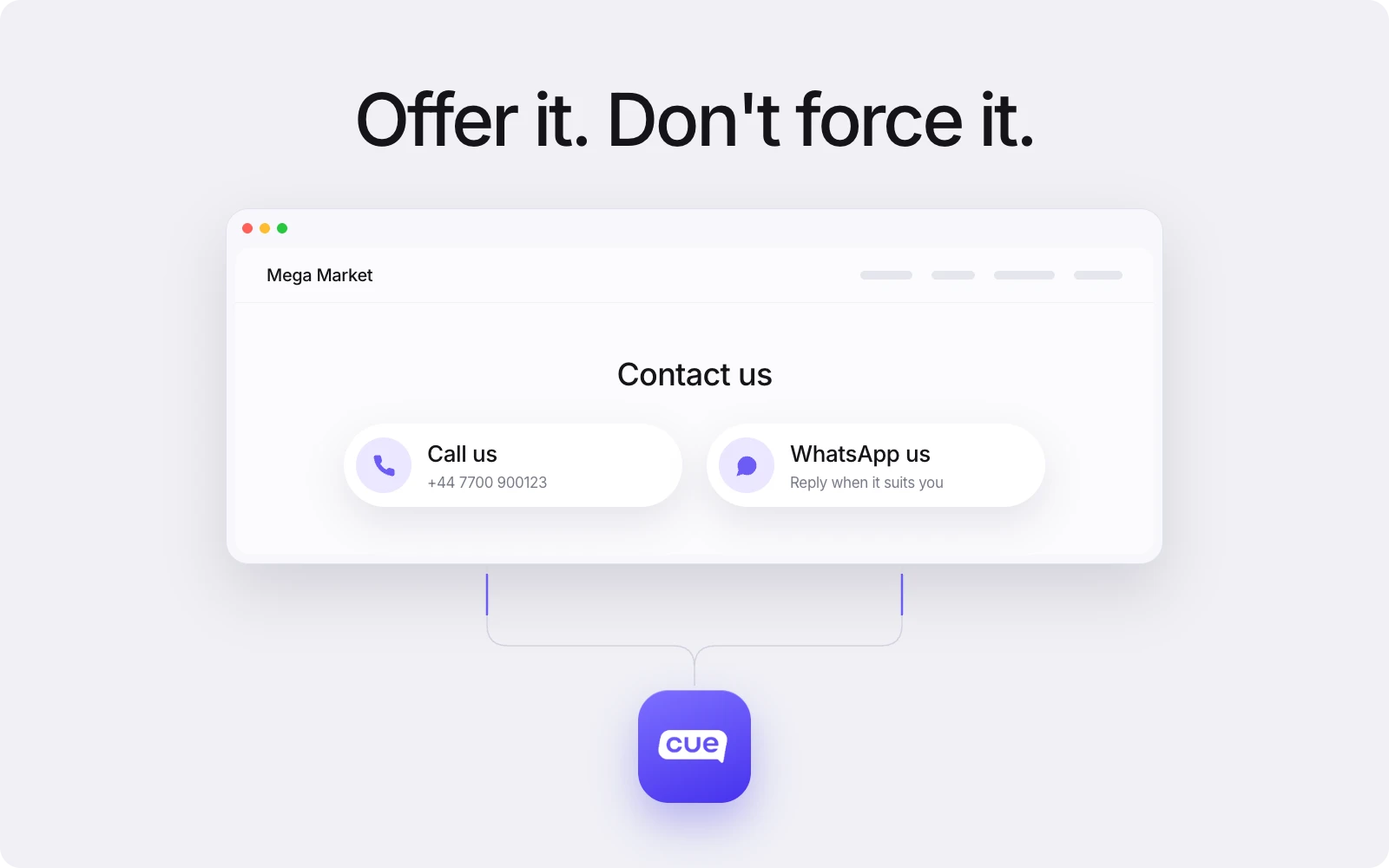
Moving routine enquiries to WhatsApp can free up the phone for the urgent and complex calls that need it. But a customer who wants to talk and gets pushed to a chat window has just had their preference overruled. The UKCSI figures show how much a route to a person matters to them.
A few ways to offer it without forcing it:
Keep your phone number visible next to your WhatsApp link, not hidden behind it.
Use your out-of-hours message to point callers to a channel that’s answered, such as WhatsApp, so they have somewhere to go when the lines are closed.
When an agent finishes a call, mention that the customer can follow up on WhatsApp if that’s easier for them.
If a call is missed, call the customer back. In Cue, agents can call back from the contact record.
The goal is fewer customers stuck in the wrong channel, not fewer calls for the sake of it.
A channel-choice worksheet
Use this worksheet to decide, enquiry by enquiry, where each conversation should start and who owns it. List your ten most common enquiries and fill in one row for each.
Enquiry | Preferred first channel | Escalation trigger | Owning team | Information needed | Promised next step |
|---|---|---|---|---|---|
Repair status | Customer disputes the estimate | Service desk | Job number, vehicle registration | Update by end of day | |
Billing error | Phone | Refund over an agreed amount | Accounts | Account number, transaction date | Callback within one working day |
Your enquiry |
The two examples are illustrations. Your triggers, owners and promises will be different.
When you measure how it’s working, look at resolution and customer effort as well as call volume. Fewer calls can mean customers are getting what they need elsewhere. It can also mean they’ve given up.
Keep the phone, fix the route
Customers still want to call when it matters, and they still want a person when automation can’t help. The work is in the hand-off between channels.
If messaging is where you want to start, see how Cue handles WhatsApp for customer service. If you want calls and messages on the same customer record, take a look at Cue Phone. And if you’d like to talk through your own channel mix, book a demo.