A dealer group handles calls well across its sites when three things are settled: who owns each type of enquiry, how a call reaches the team that can deal with it, and how the next action stays visible once the call ends. Get those right and the phone system has a clear job to do. Get them wrong and a new phone system just moves the same problems around.
So treat this as a process decision first. The technology question comes after you’ve decided how enquiries should flow between your sites, your departments and any central team.
Where multi-site call handling breaks
Very few groups set out to design a messy call process. It builds up as sites are acquired, brands are added and staff find their own workarounds. These are the weak points to look for:
Manual transfers. Reception picks up, asks what the call is about and tries the workshop. If nobody answers, the customer goes back to the switchboard or is told someone will ring back, with no record of who promised it.
Personal mobiles. Service advisers and sales executives give customers their own numbers to stay in touch. The conversation then lives on one person’s phone. When they’re off, on holiday or leave the business, the history goes with them.
No visibility across sites. Head office can’t easily tell which sites are answering, which ones are swamped at 8.30am, or where callbacks are piling up.
Customers calling the wrong site. Someone rings the branch they bought from about a service booked at another branch, or calls the sales line about a recall. Each wrong number adds a transfer, and each transfer is another chance to lose the call.
None of these is really a telephony fault. They’re ownership problems that happen to show up on the phone.
Site-led, central or hybrid?
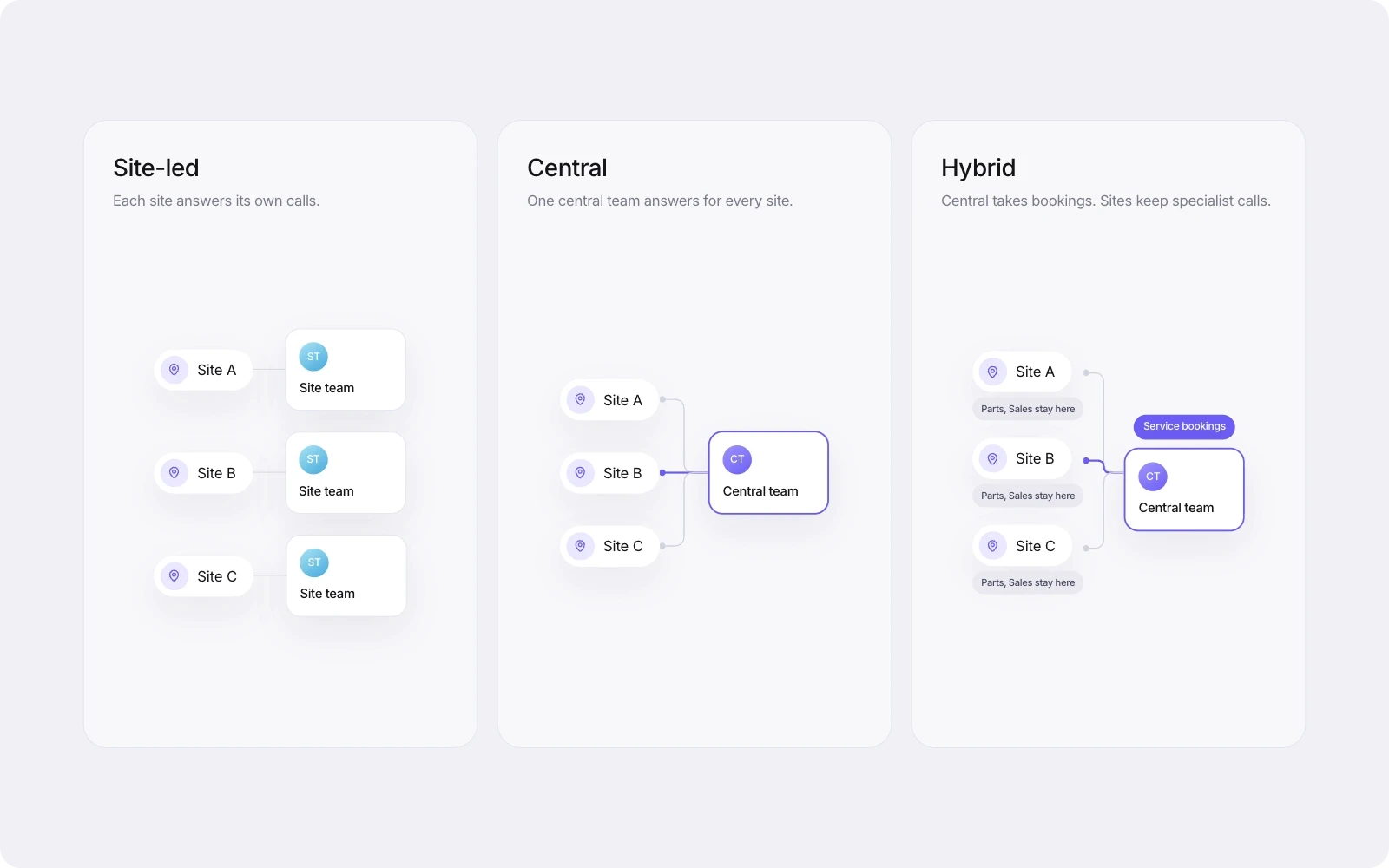
A dealer group can organise calls in three broad ways. In a site-led model, each dealership answers its own calls. In a central model, calls go to a group team that handles first contact for every site. In a hybrid model, a central team takes certain enquiry types, such as service bookings, while questions that need local or specialist knowledge stay with the site. The choice between them comes down to coverage, specialist knowledge, ownership and how much head office can see.
Site-led | Central team | Hybrid | |
|---|---|---|---|
Coverage | Depends on each site’s staffing and hours | Easier to cover peaks and longer hours from one pool of people | Central team absorbs volume; sites cover specialist work |
Specialist knowledge | Strong. The people who know the car and the customer pick up | Weaker on site-specific detail unless the team has good information to hand | Kept where it matters, as long as hand-offs are clear |
Ownership | Clear locally, but rules can differ from site to site | Clear at first contact, but can blur when a site needs to act | Needs written rules for who owns what after a hand-off |
Head office visibility | Hard to compare sites | One team is easier to see | Depends on whether central and site activity sit in the same place |
Main risk | Calls going unanswered when a site is busy or short-staffed | Customers feeling passed around | Enquiries stalling at the hand-off between central and site teams |
Vertu Motors is one real-world example of a hybrid. Its careers site describes a central customer experience operation that includes central reception, inbound and outbound service-booking teams, an internet sales function and a parts hub that works with its dealerships. The useful point for other groups is that central and site-based work can sit side by side.
No single model suits every group. A three-site independent and a large franchise group will land in different places. What matters is that the choice is deliberate and written down, so every site knows where its responsibilities start and stop.
Mapping enquiries to the right team
To route calls well, list the enquiries customers call about, then decide five things for each one: which site and department handles it, what expertise it needs, the hours it’s covered, where it overflows when that team is busy, and who owns it if nobody picks up.
A service booking might go to a central bookings team from 8am to 6pm, overflow to the site’s service desk, and fall back to the site’s aftersales manager. A query about a part on order might go straight to the parts hub. Once you’ve written this down, the routing almost designs itself.
There are two common ways to get callers to the right place:
A separate number for each site. This suits customers who are loyal to their local branch and already have its number.
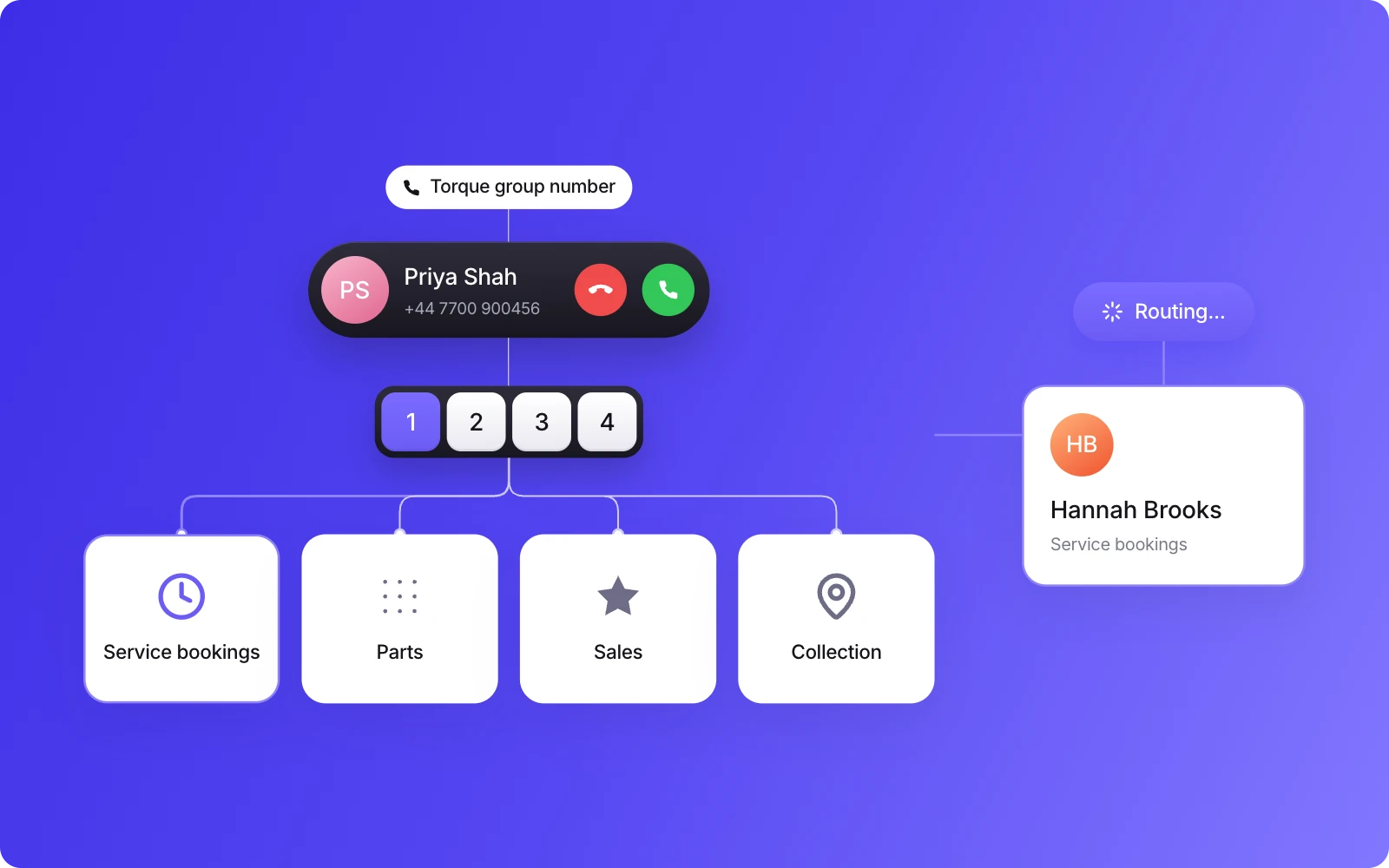
One group number with a keypad menu. Callers press a number to choose their location or department. This suits groups that want one published number and a consistent first experience.
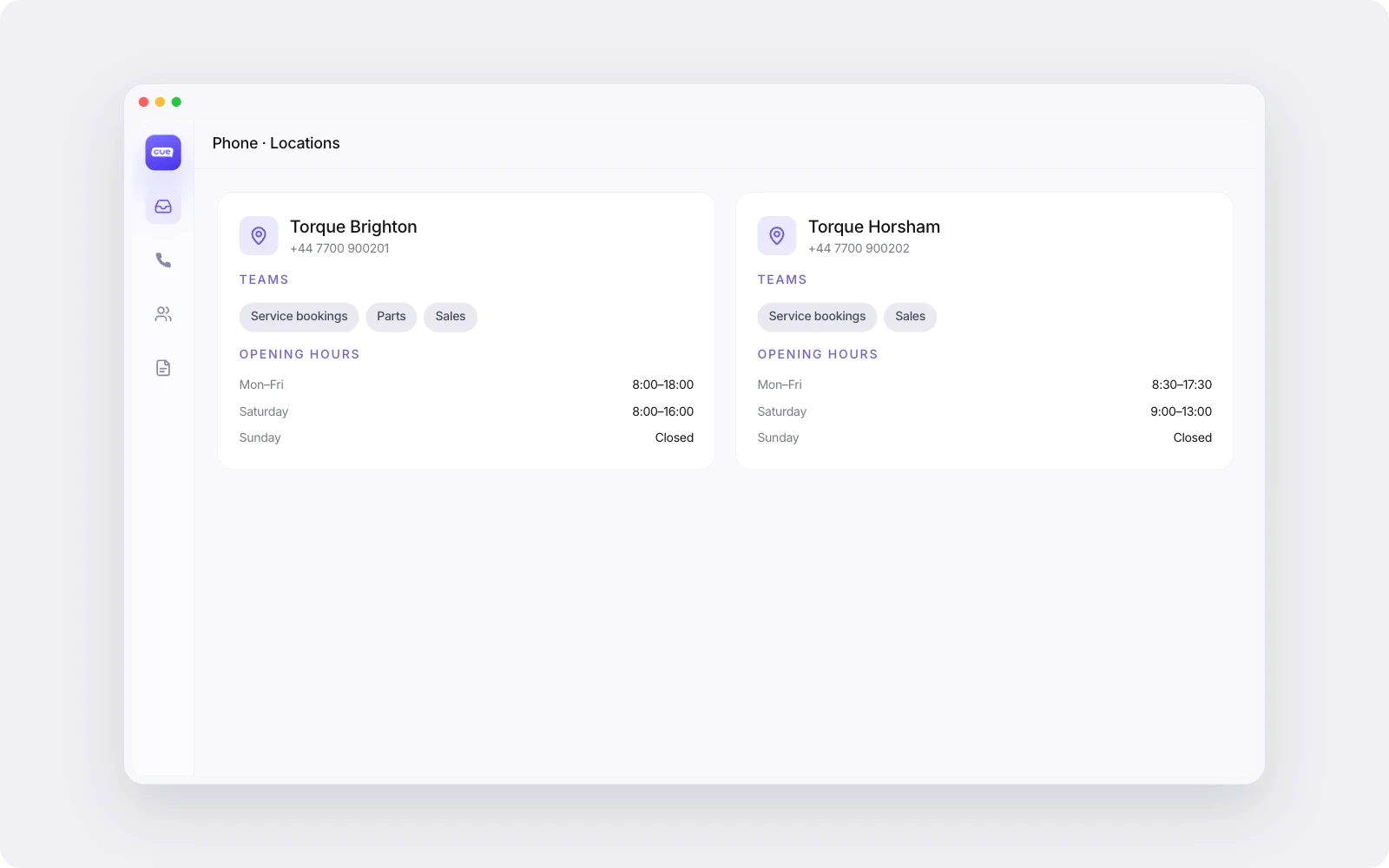
With Cue Phone you can do either. Each site can have its own number, or one number can route callers to the right location through a keypad menu with up to 12 options. Teams and opening hours are set per location, and each location can have its own WhatsApp entry point too. Within a team, you choose how calls are shared out: round robin, least calls today or longest idle. Agents can hold a call and make a warm or cold transfer when the caller needs someone else.
Get a new UK or South African number through Cue, or bring your existing number across. Numbers in other countries are available on request.
For more on menus, greetings and how calls are distributed, see our guide to inbound call handling.
When a call isn’t answered
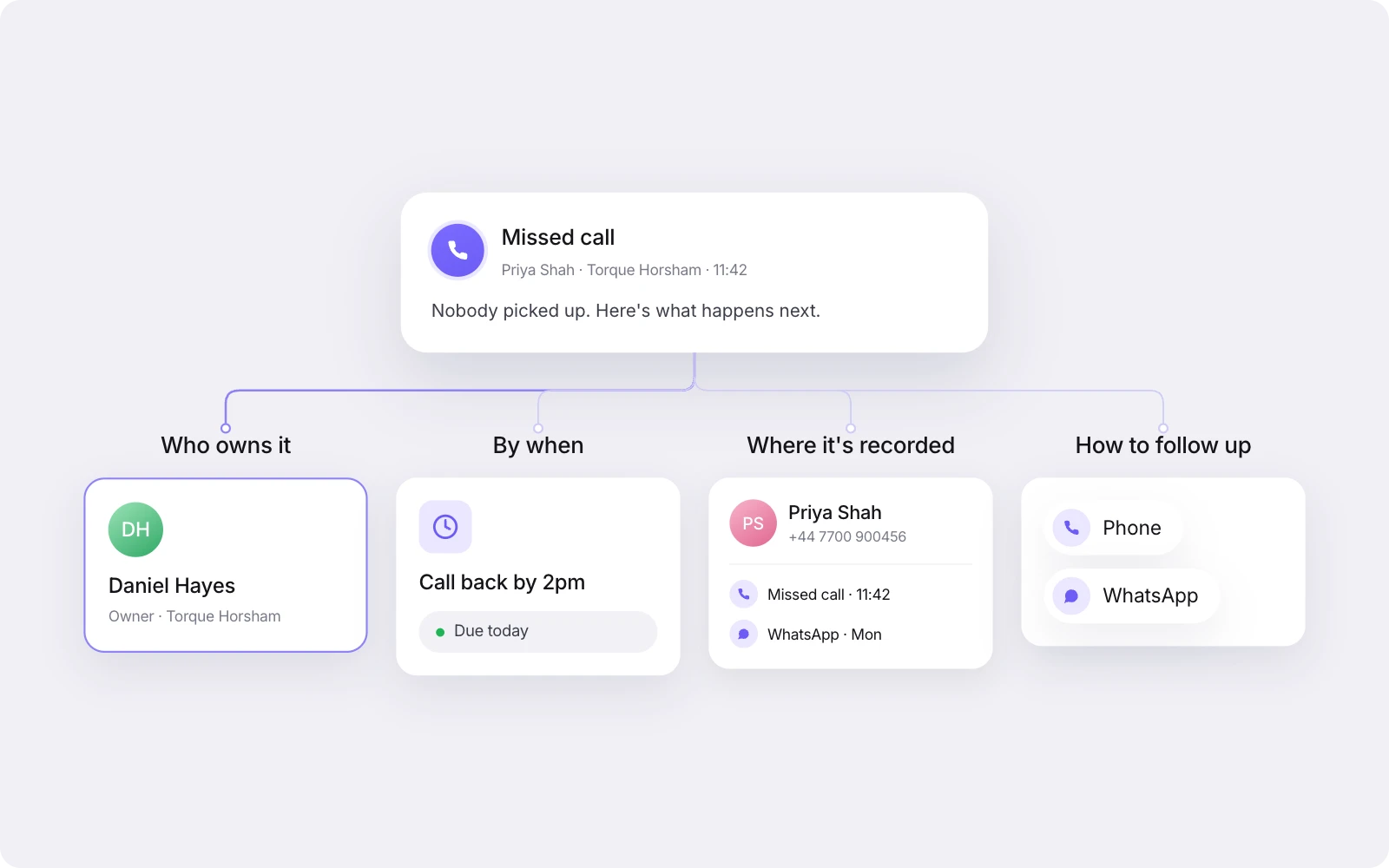
Every unanswered call needs an owner, a deadline and a place where the follow-up is recorded. Without those, “we’ll call them back” relies on someone remembering.
It’s worth getting this right. In the Institute of Customer Service’s UK Customer Satisfaction Index (UKCSI) for July 2026, 32.6% of customers ranked “ability to speak to someone when I need to” in their top three priorities, while only 15.8% thought organisations prioritise it. Speaking to someone isn’t always a phone call, but a missed call with no follow-up is one of the clearest ways to let that customer down. The same report recommends mapping the hand-offs between channels, and an unanswered call is exactly that kind of hand-off.
Decide these points for each enquiry type:
Who owns it. The site team, the central team or a named fallback person.
By when. Set a callback window. A customer asking about collecting their car today needs a faster response than a general sales question.
Where it’s recorded. On the customer record, not a notepad or a personal phone.
How to follow up. Let the customer choose. Some want a call back. Others would rather get a WhatsApp message they can answer when it suits them.
In Cue, you can set a maximum wait time for callers when no agents are online. Out of hours, a message plays. Write that message to point callers to a channel that is answered, such as WhatsApp, and tell them what will happen next. The callback itself is a person’s job: agents can call the customer back from the contact record.
Aftersales calls
Aftersales is where multi-site call handling is tested hardest. One customer can call about a booking, then ring to ask “is my car ready?”, then call again about collection, and each call may need a different person.
It helps to split aftersales calls by what they need:
Bookings need someone with sight of workshop capacity. This could be a central bookings team or the site service desk.
“Is my car ready?” needs the service adviser or the workshop. These calls interrupt the people doing the work, so proactive updates can cut them down.
Collection and payment needs the site, with the invoice and the opening hours.
Status updates and collection details can work better as a message than a call, because the customer can read them whenever they like. Our guide to WhatsApp vs phone calls for dealership communication goes through which aftersales conversations suit each channel. Cue customers have seen this with WhatsApp. Stellantis increased its after-hours contact rate from 74% to 87%. Worthing Motors gained an extra £5,000 in quarterly OEM rebate and saw follow-up responses rise by 55%. These are WhatsApp results, not phone results, but they show what happens when routine aftersales contact moves to a channel customers can answer in their own time.
See how Cue supports automotive aftersales, or read about WhatsApp Business with Cue. If you want to automate parts of those WhatsApp journeys, look at Flows.
What head office should see
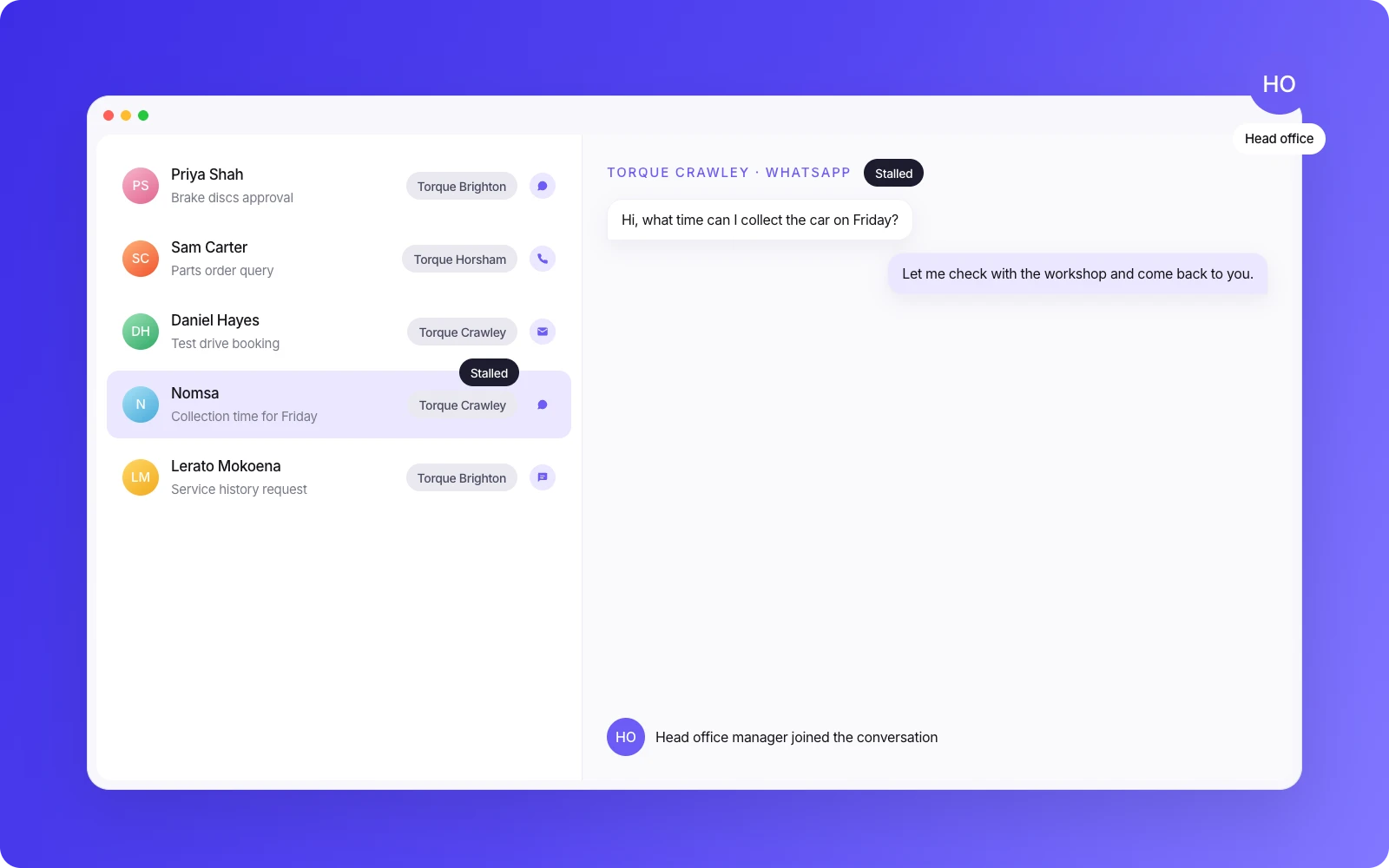
Head office needs enough visibility to spot a site that isn’t answering, callbacks that haven’t happened and hand-offs that have stalled. The simplest way to get it is to agree a small set of measures and define them the same way for every site.
Measure | How you might define it |
|---|---|
Answer rate by site | Calls answered during opening hours ÷ calls received during opening hours, per site |
Callbacks completed | Callbacks made within your agreed window ÷ callbacks owed |
Unowned enquiries | Enquiries with no named owner after a set number of hours |
Hand-offs completed | Central-to-site hand-offs acted on within the agreed time |
These are definitions for your group to agree, not industry benchmarks. Set your own targets from your own starting point.
Measures tell you where to look. Managers also need to be able to act. In Cue, head office can see and step into conversations across sites in the same inbox, so a manager can pick up a stalled enquiry without waiting for a report.
Letting the customer record follow the customer
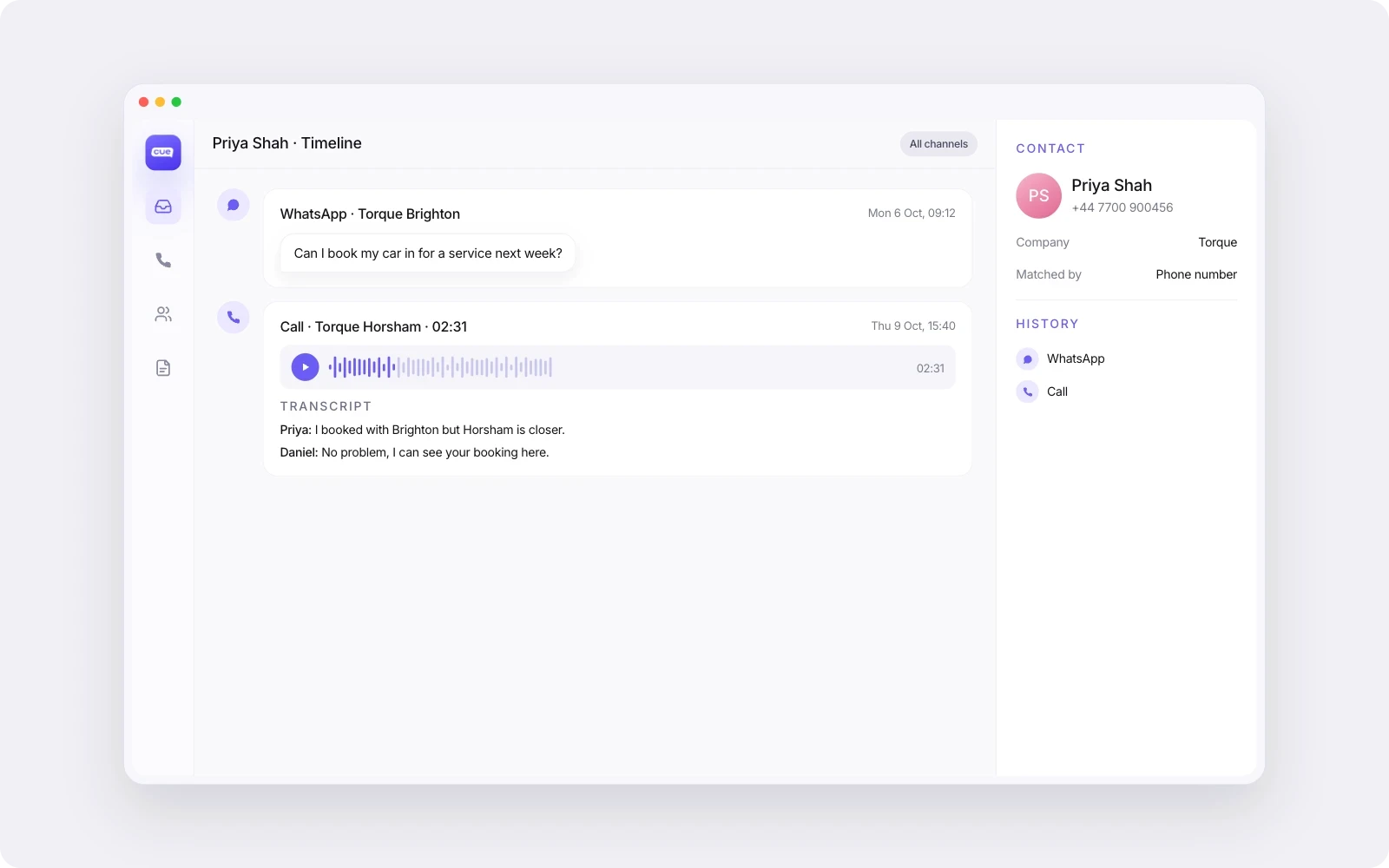
A customer who bought from one site and services at another shouldn’t have to repeat themselves. That only works when the history sits with the customer, not with the site or the person who last spoke to them.
In Cue, callers are matched to contacts by their phone number. Calls can be recorded and transcribed, and recordings and transcripts sit on the contact record alongside WhatsApp, email and chat history. Whichever site picks up, the agent can see the whole conversation so far. If you record calls, agree your recording policy first and make sure callers are told.
A multi-site call and follow-up audit
Use this audit to check how your group handles calls today. Fill in one record for each enquiry type at each site. Gaps and “it depends” answers show you where calls are likely to go missing.
Field | Question to answer | Example: service booking, Site A |
|---|---|---|
First contact route | How does the customer reach you first? | Group number, keypad option 1 |
Owning team | Which team owns this enquiry? | Central bookings team |
Coverage hours | When is that team available? | Monday to Friday, 8am to 6pm; Saturday, 8am to 12pm |
Overflow | Where does the call go when the team is busy? | Site A service desk |
Owner of unresolved enquiries | Who is accountable if nobody picks up? | Site A aftersales manager |
Permitted follow-up channel | How can you follow up? | Phone call back or WhatsApp, as the customer prefers |
Where it’s recorded | Where does the follow-up live? | Customer contact record |
How it’s measured | Which measure tells you it’s working? | Callbacks completed within four working hours |
Run it with site managers and your central team in the same room. Where people disagree, you’ve found the gaps worth fixing first.
Start with the process, then the phone system
Once you know who owns each enquiry, where it overflows and how follow-up is recorded, choosing how calls are routed is the easy part. Cue Phone gives dealer groups site-level numbers or one number with a keypad menu, teams and hours per location, and calls on the same contact record as WhatsApp.
See how Cue works for automotive groups, or book a demo to walk through your own call flow.